Sunday, 7 October 2012
IRAN: HOW TO SOLVE A PROBLEM LIKE A NUCLEAR-ARMED IRAN
This week's article is written by a guest weblogger, Uche Ndaji. Miss Ndaji is a Law graduate with a keen interest in international law and global affairs. She is also an aspiring novelist, poet and writer of the short story form.
The 67th United Nations General Assembly meeting once more highlighted the intensifying political tension between Iran and Israel which has been fuelled by Iran’s burgeoning nuclear ambitions.
IAEA Report
Iran’s latest refusal to consent to an inspection by the International Atomic Energy Agency (IAEA) not only heightened suspicions about the country’s true motives for pursuing the nuclear programme but has also become the proverbial ‘red rag’ to Israel’s ‘bull’. Notably, the IAEA’s September 13th resolution which raised concerns about the ferocious pace at which the Fordow Fuel Enrichment Plant had advanced and in turn the threat which it posed to international peace and stability bolsters Israel’s claims regarding Iran’s intended purpose for embarking on the project.
Tough Questions
Some might question the widespread objection to Iran’s enrichment programme since nuclear warheads have so far not been produced nor can observers assert with confidence that they will be constructed in the near future. How seriously should President Mahmoud Ahmadinejad’s posturing be taken? Why is the West quick to dismiss the Iranian government’s assertion that its nuclear programmes are intended for peaceful purposes while Security Council members keep nuclear stockpiles in readiness for potential use? What will unilateral strikes by Israel on Iran’s plant do to diffuse or escalate the instability in the Middle East?
The unanswered questions lead one to doubt that a resolution to the region’s peace and security problems will be arrived at in the immediate future. At the same time however, they are legitimate queries which demand valid answers.
The Case for and Against ‘Pre-Emptive Strike’
According to the New York Times, “international nuclear inspectors confirmed that Iran had installed three-quarters of the centrifuges it needs to complete a deep-underground site for the production of nuclear fuel.” Assuming there is an inkling of truth to the allegation, certain concerns arise bearing in mind recent history of the intelligence errors which resulted in the ghastly mission that was the last Iraq war.
Like Saddam Hussein, President Ahmadinejad’s petulance can be dismissed as a façade, a sorry attempt at attracting international attention to his many baseless causes for instance: “wiping Israel off the map” whilst declaring that “the regime is on its way to annihilation.” Ahmadinejad’s venomous language continued to flow at the General Assembly where he reiterated that “Israel has no roots in the Middle East.”
Yet how can the UN separate suspicions of the Iranian government’s nuclear ambitions from Ahmadinejad’s inflammatory rhetoric? One can certainly draw parallels with Saddam Hussein who misguidedly engaged in similar ‘war games’ with the international community about his alleged possession of chemical weapons. With the benefit of hindsight which of course is the best sight, Hussein’s antics appeared to have been a defence mechanism, or better yet, merely a ruse to fend off intimidation from neighbouring states.
Iraq Parallels
Evidence provided by the Iraq Survey Group in 2004 concluded that Saddam Hussein’s government possessed no chemical weapons thus validating the illegitimacy of the conflict. Yet, there is a telling distinction between both circumstances; Iran is actively expanding its nuclear program whereas Saddam Hussein remained pigheaded and somewhat unpredictable with regard to ownership of biological and chemical weapons leading to a sweeping assumption that his government embarked on the proliferation of nuclear weapons.
Lessons should have been learned from the Iraq crisis for the reason that, without comprehensive evidence and concrete substantiation of the existence of nuclear weapons, pre-emptive strikes must be avoided at all costs.
Furthermore, it is important to point out that nuclear programs can in fact be used for ‘peaceful purposes’ as claimed by the Iranian government. For example, Japan uses its nuclear plants to generate electricity although its dependence on nuclear power remains somewhat controversial following the meltdown of the Fukushima Daichii Nuclear Power Plant after a devastating earthquake and the subsequent tsunami which ravaged much of the country in March 2011.
Unlike Japan, some of the doubts facing Iran’s nuclear programs are exacerbated by its hateful denouncement of Israel, questioning Israel’s existence and its promise to eliminate Israel. When nuclear development is added to the framework, doubts set in consequently discrediting the ‘peaceful’ nature of such programmes.
The Potential for War
Finding a solution appears more difficult than the crisis itself. Prior to the General Assembly meeting, Israeli Prime Minister Benjamin Netanyahu restated the importance of setting a ‘red line’ on Iran’s nuclear expansion. Mr. Netanyahu backed up this statement in flamboyant fashion at the meeting with a visual chart, highlighting the 90% point at which military strikes would be appropriate to stop Iran’s uranium enrichment.
Talks of a unilateral strike on Iran by the Israeli government have circulated for months, although the United States opts for a diplomatic solution through economic sanctions and has so far avoided all suggestions of military action. The eagerness for conflict seems to have diminished from the Obama government’s discourse and the Iranian government keeps a close eye on this. Some state that the US government has suffered enough financial strain as a result of the Iraq war which Iran is all too aware of and has sought to capitalize upon.
The Effect of Sanctions
However, claims last week that EU and US sanctions have sent the Iranian economy into free fall gathered pace with The Guardian reporting an overwhelming 15% depreciation of the rial. The diminishing accessibility of foreign currency and inflationary food prices resulted in the Israeli Finance Minister Yuval Steinitz’s proclamation that the Iranian economy is “on the verge of collapse” as reported by Reuters.
Evidently, sanctions are somewhat effective though it needs reminding that Iran’s foreign currency reserves can still be used to galvanise its economy which would ultimately render the sanctions useless. What appears interesting is how far the sanctions can go to prevent Iran from acquiring nuclear arms. Will further sanctions be invoked to stop Iran from accessing its foreign currency reserves? Would global financial isolation convince the government to curtail its nuclear activity?
Regrettably, sanctions affect ordinary citizens who are innocent bystanders and who are also in the thrall of this regime. The hardship caused by the sanctions could have the counter-productive effect of pushing the country’s citizens into extremism, thereby intensifying the level of distrust, which is already at an all time high, between the West and the Muslim world. As we have learnt from our planet’s complex politics, sanctions do not always affect the politicos or theocrats as they can easily serve as a recruitment drive for the respective government’s anti-western campaigns.
So Where Do We Go From Here, What Happens Next?
It is unlikely that the Israeli government will follow through with threats of a unilateral pre-emptive strike on Iran’s nuclear facilities without the participation of its great ally, the United States. Needless to say the unilateral pre-emptive strike would be an unfortunate decision considering the fragile political state of the Middle East, what with Syria, Yemen and Lebanon being in the grip of unrelenting internal turmoil.
One can take comfort in the knowledge that the UN and IAEA appear to be more in control of this situation than it was in its handling of the Iraq affair if evidence is to be scrutinized. One hopes that the lessons learnt from the past will bolster academic arguments against the concept of ‘pre-emptive strike’ currently favoured by the U.S neo-cons and the Israeli government.
Sunday, 30 September 2012
MALI: U.N. PONDERS MALI GOVERNMENT’S REQUEST FOR MILITARY INTERVENTION
Last week’s news that the West African country has called on the United Nations (U.N.) to intervene militarily in order to reclaim parts of the country currently controlled by Islamist militants, though welcome, raised several eyebrows and subsequently questions amongst followers of the country’s recent fortunes. The most vital of the questions which have arisen are whether the call for intervention has come too late and secondly, whether the said intervention will achieve its desired aims if approved by the UN.
Recent History
Prior to the unfolding of the events of March of this year, Mali had been hailed by observers as one of the few democratic success stories in Africa. In March of this year however, and borrowing from the Nigerian author Chinua Achebe’s seminal masterpiece, things fell apart when a gang of soldiers initiated a coup d’etat which saw to the overthrow of the nation’s President. A combination of forces, namely Tuareg rebels who have always had an axe to grind with the government following decades of claims of marginalisation, together with various groups of Islamist militants acting jointly and severally launched an operation against the establishment which has resulted in the Northern region of the country being fully under their control. It is also reported that people in that region of the country are now subjected to Sharia law, which is the strictest form of Islam.
Call for Intervention
The call for intervention was said to have been made by way of a letter sent by the Malian government to the U.N. Secretary General Ban Ki-moon, the contents of which were revealed by the French Foreign Minister Laurent Fabius. In calling for a U.N. resolution under Chapter 7 of the U.N. Charter, under which the U.N. can authorise military interventions, the Malian government stated that terrorists, drug dealers and criminals currently occupy areas of the country and as such it needed the support of an international force “to help the Malian army to reconquer the occupied areas of northern Mali.”
Mali’s request for intervention was met with a rather familiar obstacle in a divided United Nations. At a special summit arranged by the U.N. to address all things Mali-related and held against the background of the recent U.N. General Assembly, the Malian Prime Minister Cheick Modibo Diarra stated: “There is an urgency to act to end the suffering of the people of Mali and to prevent a similar situation that would be even more complicated in the Sahel and the rest of the world.” Diarra’s impassioned plea for assistance was supported by the country’s Colonial Father, France who’s President Francoise Hollande pledged his country’s support to the idea of a potential military action.
Reservations to Calls for Intervention
Whilst France had no reservations in throwing its hat in the ring in support of military intervention, the reverse was the case with the US who appear to be exhibiting more restraint than they have been associated with in recent times, perhaps an indication of their reduced influence in the global politics arena. Hilary Clinton, the country’s Secretary of State insisted that a legitimate government had to be put in place before such an action could be considered. In respect of what can only be described as the multi-dimensional nature of the problems currently facing Mali, Clinton stated: “This is not only a humanitarian crisis; it is a power keg that the international community cannot afford to ignore.” She continued “in the end, only a democratically elected government will have the legitimacy to achieve a negotiated political settlement in northern Mali, end the rebellion and restore the rule of law.”
Clinton’s stance has also received support from the U.N. Secretary General who has also raised reservations regarding the topic of military intervention on the ground that it may further exacerbate the already critical humanitarian crises in the region.
The Future
Although the American call for caution in respect of the potential for military action is comprehended, a legitimate question which then arises is how democratic elections can be held in a country where a sizeable area is controlled by Islamist militants who abhor the concept of democracy and accordingly the principles and ideals associated with it. Furthermore, it is becoming increasingly clearer by the day that diplomacy may be futile in salvaging the situation. The July 5 Security Council sanctioned ECOWAS (The Economic Community of West African States) mission which was mandated to apply political means to resolve the conflict hardly made any notable gains despite its credible efforts. Its failure was no doubt significantly handicapped by the difficulty in identifying all the warring factions in order to commence any form of effective negotiations as Al-Qaeda is only but one of the several Islamist militant groups said to be operating in the northern region of Mali.
Sound-off
Whilst the U.N.’s sounds of caution are laudable its prevarication on the same subject has already contributed to the humanitarian crises facing the region and clearly lessons have not been learnt. A rational move at this point would be the authorisation of ECOWAS troops – who have indicated its preparedness to send troops at short notice – in order to quell the flames emanating from the nation’s combustion. Sooner rather than later the U.N.’s leadership will be forced to make the decision it has attempted to circumvent for some time which in sum amounts to whether the benefits of military intervention outweigh the potential of a worsening of the humanitarian crises which has resulted in the displacement of hundreds of thousands of innocent Malians.
Sunday, 23 September 2012
GEORGIA: PRISON ABUSE SCANDAL ROCKS GEORGIA IN LEAD UP TO PRESIDENTIAL ELECTIONS
Georgia’s President Mikheil Saakashvili appears to be suffering the same torrid fate which has befallen his incumbent contemporaries in the lead up to presidential elections in their respective countries.
With leadership elections due on October 1, Saakashvili already faced an uphill task to secure re-election, what with the country’s stagnating economy – an experience which is not too dissimilar from the rest of the continent - and its people discontent with a government seen by many to have no qualms about encroaching on their civil liberties and freedom. Unfortunately for Saakashvili and his supporters his problems have been further compounded by recent videos released by his political opponents which show gross abuse of prisoners by the authorities.
As expected the images have drawn the ire of the public and the furore which emanated as a result has failed to dissipate into the ether with the rapidity which Saakashvili seeks. The broadcast of the images by television stations allied with the country’s opposition parties has led to days of protests by individuals who have taken to the streets in their thousands to denounce the authorities.
To his credit Saakashvili has moved to distance himself and his party from the images which show prison authorities indiscriminately beating, allegedly raping, manhandling and hitting prisoners. The chief of Tbilisi prison where the abuse was recorded, his deputies and prison guards with alleged involvement in the debacle have been detained by the authorities. The country’s Interior Minister Bacho Akhalaia resigned earlier in the week and Saakashvili has also this week appointed a new Prisons Minister in Georgy Tugushi following the resignation of the minister in charge of the prisons at the time of the scandal.
Controversy still surrounds the production of the video and how it happened to have been acquired by the media. According to the global news agency Reuters, Saakashvili’s United National Movement party claim that the videos were staged and the recording filmed by guards who had been bribed by “politically motivated persons”. Whatever the origins of the video, the Organisation for Security and Cooperation in Europe (OSCE) and the Council of Europe (COE) have weighed in on the scandal and urged Saakashvili to bring those culpable to justice and also reminded the government of the duty to maintain human rights standards across the nation.
The revelations which surfaced at such a late phase in the presidential campaign comes as a gift to the Georgian Dream coalition led Bidzina Ivanishvili and no doubt has the capacity to significantly hurt Saakashvili’s re-election ambitions although not enough, in the current writer’s opinion, to decimate the 20 percentage points cushion which the United National Movement had over its opponents before the scandal broke and by election day.
Monday, 10 September 2012
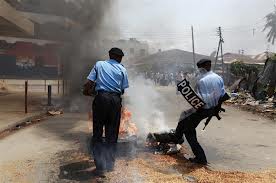
KENYA: RENEWED VIOLENCE LEADS TO FEARS OF A REPRISAL OF 2007’s DEADLY CONFLICT

Last week’s discovery by the Kenyan authorities of over 150 explosive devices in the country’s capital city of Nairobi indicates that the country’s battle against Islamic militants is far from seeing its end. Close observers of Eastern African affairs recall last year’s Kenyan incursion into Somalia aimed at deterring the Somalia-based Islamist group, al Shabaab, who were alleged to have been behind a spate of terror attacks on Kenyan soil.
Many Kenyans will probably concur with the assertion that its government’s incursion into Somalia, although well intentioned, has been counterproductive at best and its consequences disastrous at worst. The incursion has also resulted in conflict between the country’s Christian and Muslim populations and the recent discovery of explosives will no doubt further compound the distrust between members of both communities.
Tensions were stoked even further last week following the arrest of the Muslim cleric, Abubaker Sharif for his part in inciting violence in the country’s second biggest city Mombasa which led to the deaths of five people. Sharif, a divisive figure who has previous form when it comes to incitement, is alleged to have called on his followers to eliminate senior Islamic figures adjudged to have collaborated with the government, to burn churches and attack police officers.
The spiralling conflict with al Shabaab comes against the background of alarming sectarian violence in Kenya’s coastal regions which have been linked to disputes over resources between pastoralists and settled farmers. Last week’s clashes resulted in the deaths of 11 people and occurred in spite of calls from the country’s leaders, including that of its Prime Minister Raila Odinga, for an end to the violence. Of concern is that the parallel conflicts have the potential to morph into the violent scenes which followed from Kenya’s last presidential elections in December 2007 which led to the deaths of over 1,200 people.
Whilst the government’s attempts to quash the scourge presented by Islamic militants by sanctioning the military exercise in Somalia has been referred to by many as constituting the origin of the present conflict, it is well worth adding that identifying the root cause of the latest violent scenes may not be as simplistic as some would like to think. As was the case in the bloody violence which occurred half a decade ago the fight for limited resources is a major factor and element in this troubling equation which must not be discounted.
Muslim communities who outnumber their Christian contemporaries in the country’s coastal regions complain rather vociferously about losing jobs and land to members of the Christian communities. Adding to these are issues to do with unemployment mostly amongst members of the Muslim community thereby increasing the potential of the radicalisation of youth who feel marginalised and in some cases are reported to have been recruited by the al Shabaab Islamic militia in their battle against the Kenyan government. Perhaps the only certainty in this otherwise uncertain circumstance is that there will be no end to the Kenyan crises until its government adopts a multifaceted approach in confronting its problems as opposed to its current one dimensional modus operandi which fails to address the underlying social, political and economic problems facing its people.
Sunday, 2 September 2012
ANGOLA: VOTERS CHOOSE STATUS QUO OVER NEW DAWN

Angola’s President Eduardo Dos Santos appears not be giving up easily in what seemingly has become a 2-man race or contest between himself and Equatorial Guinea’s President Teodoro Obiang Nguema Mbasogo to be crowned Africa’s longest serving leader.
Election Results
Last week Dos Santos was elected by way of a landslide victory to serve a further five-year term as President. Currently aged 70 and having already led the country for 33 years, Dos Santos will be 75 by the end of his tenure. Early reports indicate that Dos Santos’s MPLA party won about 70 per cent of the votes while the rest was split between opposing parties UNITA and CASA-CE. Although MPLA’s victory was overwhelming this time, it was not as decisive as the 2008 elections where it amassed about 81 per cent of the votes.
Questions and Protests
As we are all too aware, no elections held in Africa passes without controversy and problems. It therefore comes as no surprise that the validity of the elections have been challenged by the government’s opponents. Concerns have been raised over alleged rigged ballots and the transparency of the election process. In an interview with the Reuters news agency following the announcement of the provisional results, a candidate seeking election on the platform of the opposing CASA-CE party William Tonet denounced the elections as “cheating”. Tonet added that the election results amounted to a “declaration of war” by MPLA.
The leaders of the country’s second largest party UNITA have also voiced their intention to challenge the election results. Pre-election, observers will recall that the party’s leader Isaias Samakuva called for the postponement of the elections for another month as a result of what he termed interference in the election process by the ruling MPLA as well as questions raised over the credibility of the country’s national election commission (CNE).
Giant Leaps
The disquiet which has stemmed from the elections should however not detract from the progress, in gargantuan proportions, which the country has made since the end of its 27-year long civil war which devastated the nation. Now Africa’s second largest oil producing country, its oil wealth has served as the fulcrum of its economic transformation. It is reported that the country experienced an average of 15 percent growth in the period between 2002 and 2008. Further and even more impressive is the fact that Angola reported the world’s highest annual average GDP growth at 11 percent between 2001 and 2010.
Sound-off
Unsurprisingly and much like its oil producing African counterparts Nigeria and Equatorial Guinea the oil wealth has failed to trickle down to those who occupy the bottom strata of its 18 million strong population and as a result endemic corruption, patronage, nepotism and poverty thrive below the glamorous face of the country which is most encapsulated by its skyscraper thronged capital, Luanda.
Perhaps in a bid to address these concerns, Dos Santos ran a re-election campaign which had at its centre the promise to reduce poverty and inequality backed by a declaration to invest $17 billion in the country’s energy sector. At the risk of being labelled a cynic or a pessimist, critics of the Dos Santos government have good basis upon which to base their damning indictments of the administration, after all Dos Santos has already had three decades to lead the country to the promised land but all he has delivered, in spite of the considerable resources which the country is blessed, is a nation with enormous social and economic disparities which may only be checked by a change of administration.
Monday, 27 August 2012
GAMBIA: PRESIDENT SET TO GO AHEAD WITH PRISONER EXECUTION

In what many would consider a ‘slow news week’, the Banjul government attracted the sort of publicity which in most weeks would have passed unnoticed under the global news radar.
Last week Amnesty International revealed that the government had executed about nine of the country’s 47 death row prisoners. Amnesty International added that further executions were to follow “in the coming days”. The recent executions come as a shock not least because the last State sanctioned execution occurred in 1985.
At the time of writing President Yahya Jammeh’s motives for persevering with the executions are still unclear although some of the executed individuals had been arrested on treason allegations. Unfortunately Jammeh’s latest pronouncements indicate that more executions are to follow. In early last week’s press release, Jammeh asserted: “By the middle of next month, all the death sentences would have been carried out to the letter; there is no way my government will allow 99% of the population to be held to ransom by criminals.”
President Jammeh’s government appears to be backtracking somewhat on the back of the criticism it has faced since Amnesty International’s revelations. In a statement released late last week the government muddied already murky waters by appearing to refer to Amnesty International’s report as mere speculation. It has to date failed to clarify either one way or the other whether it has indeed executed any prisoners at all.
Ousainou Darboe, leader of the UDP opposition party has called on the government to reveal the whereabouts of the nine prisoners said to have been executed in this seemingly first round of capital punishments. “If the government denies that any execution has taken place, it should go further and parade all those on death row on TV for their families and the public to see them. If the execution has indeed taken place, the international community should consider imposing travel bans on Jammeh and his ministers,” Darboe said.
The second strand of Darboe’s statement appears to have been assimilated and heeded by Catherine Ashton, the European Union foreign affairs supremo. In a counter statement in response to Jammeh’s threats to execute all prisoners on death row within the next month, Ashton demanded an immediate cessation of all executions. “In light of these executions, the European Union will urgently consider an appropriate response,” she added.
If the government’s latest statements are to be used as a barometer to gauge its determination to follow through on the promise of further executions, it may well appear that its appetite has been quenched by the furore which has enveloped it since its internal affairs became breaking global news. Jammeh’s unpredictability however implies that the preceding statement must be absorbed in tandem with a disclaimer. Now in his fourth term since he came to power via a coup d’etat in 1994, Jammeh continues to lead a government which pays little to no regard to matters relating to civil liberties, human rights and press freedom. In spite of his ego and unstinting obduracy the country’s heavy reliance on foreign aid means that Jammeh can ill afford to alienate the EU and the international community who are responsible for propping up its precariously unstable economy.
Sunday, 19 August 2012
BAHRAIN: GOVERNMENT CONTINUES ASSAULT ON OPPOSITION ACTIVISTS

The writer refers to Bahrain as the gift that keeps on giving, the reason being that the Bahraini government keeps on providing enthusiasts of global politics and international law with something to write about. It has certainly been successful at grabbing our collective attentions although not for the reasons it would prefer to be famous for.
Last week, opposition activist Nabeel Rajab was sentenced to three years in jail for effectively having the audacity to lead ‘peaceful’ protests against the government. The country’s courts are expected to hear his appeal next week.
Although the decision to sentence Rajab came as no surprise to observers, the length of the sentence for the ‘crime’ was even by Bahraini standards unprecedented. The EU’s foreign affairs High Representative Catherine Ashton has led calls against the Bahrain government’s anti-democratic stance. Ashton highlighted that Rajab had done nothing wrong and added that his sentencing was linked to his calls for the government to respect its citizens’ fundamental freedoms.
Victoria Nuland, the U.S. State Department spokeswoman stated that the U.S. was deeply troubled by Rajab’s sentence. She continued; “We’ve made it clear that it is critical for all governments, including Bahrain, to respect freedom of expression and freedom of assembly.” The NGO Amnesty International has gone even further than both the EU and the U.S by stating that it was a “dark day for justice.” Amnesty International’s Hassiba Hadj Sahraoui averred that Rajab’s sentence eliminates the potential for change in the country. Sahraoui affirmed: “Like many others in Bahrain, Nabeel Rajab is a prisoner of conscience, jailed solely for peacefully exercising his right to freedom of expression and assembly.”
The government’s publicity machine has since gone into overdrive in anticipation of the global opprobrium it expects to rain down upon it. The government insisted that it had evidence to hand which conclusively showed that Rajab had caused the deaths of innocent people by inciting “violence and escalation against law enforcement officers”. The country’s interior ministry also confirmed that about 700 security officers have been injured since clashes began last year. It has however failed to explain why others charged with the same offence appeared to have been given lighter sentences that that which befell Rajab.
For its part the Bahrain government has no incentive to restrain itself from maintaining the current status quo not least because its strategic location in the Middle East makes it a viable alternative as an oil transport route out of the Gulf region to the Strait of Hormuz, where Iran currently holds sway. The fact that the country also hosts the U.S. Navy’s Fifth Fleet further complicates matters thus rendering any idea of political will being mustered and mobilized by the U.S. redundant. The Bahrain government, like its Russian counterpart who drew the ire of the watching world with its absurd decision to jail members of the Russian female punk rock band, Pussy Riot last week, fails to appreciate the significance of the oft-repeated mantra spawn by the current writer. The said mantra being that the movement for change is akin to a hydra which will not cease to exist when one of its heads - the movements’ individual foot soldiers – are incarcerated or silenced.
Subscribe to:
Posts (Atom)