Showing posts with label Barack Obama. Show all posts

Monday, 10 September 2012

KENYA: RENEWED VIOLENCE LEADS TO FEARS OF A REPRISAL OF 2007’s DEADLY CONFLICT


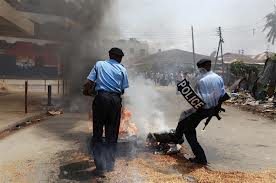
Last week’s discovery by the Kenyan authorities of over 150 explosive devices in the country’s capital city of Nairobi indicates that the country’s battle against Islamic militants is far from seeing its end. Close observers of Eastern African affairs recall last year’s Kenyan incursion into Somalia aimed at deterring the Somalia-based Islamist group, al Shabaab, who were alleged to have been behind a spate of terror attacks on Kenyan soil.

Many Kenyans will probably concur with the assertion that its government’s incursion into Somalia, although well intentioned, has been counterproductive at best and its consequences disastrous at worst. The incursion has also resulted in conflict between the country’s Christian and Muslim populations and the recent discovery of explosives will no doubt further compound the distrust between members of both communities.

Tensions were stoked even further last week following the arrest of the Muslim cleric, Abubaker Sharif for his part in inciting violence in the country’s second biggest city Mombasa which led to the deaths of five people. Sharif, a divisive figure who has previous form when it comes to incitement, is alleged to have called on his followers to eliminate senior Islamic figures adjudged to have collaborated with the government, to burn churches and attack police officers.

The spiralling conflict with al Shabaab comes against the background of alarming sectarian violence in Kenya’s coastal regions which have been linked to disputes over resources between pastoralists and settled farmers. Last week’s clashes resulted in the deaths of 11 people and occurred in spite of calls from the country’s leaders, including that of its Prime Minister Raila Odinga, for an end to the violence. Of concern is that the parallel conflicts have the potential to morph into the violent scenes which followed from Kenya’s last presidential elections in December 2007 which led to the deaths of over 1,200 people.

Whilst the government’s attempts to quash the scourge presented by Islamic militants by sanctioning the military exercise in Somalia has been referred to by many as constituting the origin of the present conflict, it is well worth adding that identifying the root cause of the latest violent scenes may not be as simplistic as some would like to think. As was the case in the bloody violence which occurred half a decade ago the fight for limited resources is a major factor and element in this troubling equation which must not be discounted.

Muslim communities who outnumber their Christian contemporaries in the country’s coastal regions complain rather vociferously about losing jobs and land to members of the Christian communities. Adding to these are issues to do with unemployment mostly amongst members of the Muslim community thereby increasing the potential of the radicalisation of youth who feel marginalised and in some cases are reported to have been recruited by the al Shabaab Islamic militia in their battle against the Kenyan government. Perhaps the only certainty in this otherwise uncertain circumstance is that there will be no end to the Kenyan crises until its government adopts a multifaceted approach in confronting its problems as opposed to its current one dimensional modus operandi which fails to address the underlying social, political and economic problems facing its people.

Sunday, 22 January 2012

GLOBAL PERSONALITY OF THE WEEK


Wilman Villar is 1worldinternational’s Global Personality of the Week. Mr Villar, 31, a dissident and activist in Cuba died in custody this week following a 50-day hunger strike. The Cuban government’s spin doctors have gone into overdrive pronouncing that Mr Villar had been in custody following an assault on his wife and that his death was pneumonia-related. Despite the government’s assertions, members of the Patriotic Union of Cuba have claimed Mr Villar as their own.

We echo the sentiments expressed by US President Barack Obama that “Villar's senseless death highlights the ongoing oppression of the Cuban people and the plight faced by brave individuals standing up for the universal rights of all Cubans." 1worldinternational salutes Wilman Villar even in his death for standing up for what is right and in the process giving up his life for a just cause.

Sunday, 15 January 2012

RECENT SPATE OF SUICIDE BOMBINGS THREATEN TO PUSH IRAQ OVER THE PRECIPICE


The recent spate of suicide bomb attacks in Iraq has not only stoked tensions in a country criss-crossed by several fault lines but also threatens the overall stability of the already fractured Middle East region. The latest attack occurred in the Southern city of Basra this weekend which killed scores and wounded many. Initial reports indicated that 15 people had lost their lives in the attack; however, the figure has now risen to about 53 at the time of writing while around 100 are said to have been injured.


Latest Attacks

The attacker was said to have been in possession of a fake police ID and was wearing an Iraqi police uniform. Initial reports allege that the perpetrator approached a police checkpoint and appeared to hand out “sweets” to Shia Muslims making their way to a Mosque to celebrate the Shi’ite holy festival of Arbain. The suicide bomber then blew himself up in a crowd comprising mostly of police officers and Shi’ite pilgrims upon being approached by a police officer. The latest attacks add to the worrying spate of terror being unleashed against Shia Muslims in the cities of Baghdad and Nasariya which left 72 dead last week.


Operation Iraqi Freedom

The recent attacks lay bare sectarian divisions which exist in the post-Saddam Iraq only months after President Barack Obama fulfilled his campaign pledge of withdrawing US combat troops from Iraq. President Obama’s decision has met fierce criticism in some quarters as many doubt that the Iraqi state security apparatus has the capacity to contain threats posed by militants to internal security. Unfortunately, Operation Iraqi Freedom, the Bush administration-led military mission aimed at dislodging Saddam has thus far failed to yield the various promises made at its onset on 19th March 2003. In contrast the human and financial cost, as well as other as yet unquantifiable costs of the 9-year long operation appears to outweigh any benefits which even the most ardent protagonists of the Iraq war can claim the country has gained following the invasion. Harrowingly, the Lancet Journal reported in 2006 that a total of 654,965 people had lost their lives following the invasion. Figures from the US Department of Defence reveal that the U.S lost about 4,487 military personnel in Iraq since 2003. In addition, the financial costs of the war have been estimated by the US Congressional Research Service (CRS) as amounting to $801.9 billion. The “catastrophic success”, the belated term coined by George W. Bush in 2004 to describe the operation to overthrow Saddam appears now to be an overstatement when the financial and human costs of the incursion are taken into account.


Political Impasse

The country’s make-shift coalition has also been paralysed by political impasse. The stability of the power-sharing government has been threatened by allegations of favouritism, marginalisation and distrust. Tensions have been particularly fraught since an arrest warrant was issued against Iraq’s most senior Sunni Arab politician, Vice-President Tariq al-Hashemi over claims that he funded attacks on the Iraqi government and security forces. The allegations are also said to have been substantiated by individuals employed as Mr Hashemi’s bodyguards at the time. Mr Hashemi remains a fugitive in the Iraq Kurdistan region of the country and remains under the protection of the Kurdish regional government who have refused to give him up despite calls from Iraq’s Prime Minister, Nouri al-Maliki. The dispute has led to the boycott of the assembly by the al-Iraqiyya group, who are the main Sunni bloc in parliament. The group claims that the arrest warrant is merely a witch-hunt by the Shia-dominated government against the Sunni Muslim minority.


The Future

It would not be erroneous to assert that these divisions were less apparent in the ‘old Iraq’ ruled by the iron fist of Saddam Hussein. Aside the tit for tat attack by Sunnis against Shi’ite Muslims and vice versa, calls for autonomy voiced by the Kurdish area of the country and attacks against minority Christians, many of whom have left the country as a result, the country’s stability is complicated by the politics of the volatile Middle East region it finds itself in. Turkey’s attempts at asserting influence over the region, the Sunni Muslim rebellion in neighbouring Syria, the Shia majority ruled Iran’s relationship with Iraq’s Shi’ite leaders and mistrust of Sunni ruled Saudi Arabia are only but a few curve balls which the government has had to confront.

The autocratic demeanour exhibited by Prime Minister Nouri al-Maliki has played a central role in the impossible current state of affairs. The stability of the country depends on his ability to compromise with the different factions making up the power-sharing government. Any positive changes to the current state of impasse will depend on this ability; after all, this is supposed to be a ‘power-sharing’ government. Moreover, the country’s leaders need to set an example to its populace by airing out difficulties via the arena provided by the negotiating table rather than through the issuance of arrest warrants or threats issued through the media. Only then will the message seep through to the country’s people that communication rather than violence is the most effective means of settling disputes.

In addition, the country’s security apparatus needs to be significantly strengthened to protect its people from the havoc wreaked by suicide bombers. To this end, there needs to be a change of focus towards pre-emptive action by the Iraqi government and this can be achieved by enhancing its intelligence services. Perhaps, it could seek the assistance of the US in this regard although a request of this nature may compromise its relationship with Iran who are alleged to have twisted Iraq’s arms into ensuring the exit of US combat troops from the country. Importantly, it is vital for the country’s people to see tangible benefits of living in the post-Saddam Iraq. The post-Saddam Iraq is still as poor as the Saddam ruled Iraq, and to compound matters, is also less secure. The next few months are critical times for the country although its future unfortunately rests in the hands of its pugnacious leader, Nouri al-Maliki. 1worldinternational urges its readers to watch this space.