Showing posts with label Conflict. Show all posts

Wednesday, 9 January 2013

KASHMIR: INDIA AND PAKISTAN RENEW HISTORICAL HOSTILITIES

This week has seen the renewal of hostilities between two of the Asian subcontinent’s superpowers, India and Pakistan. Both have engaged in military conflicts on three occasions since 1947 when they became independent nations and the latest skirmish, once again over the disputed Kashmir region to which both parties lay claim, threatens the relative stability to which the inhabitants of both countries have recently become accustomed.

The latest threat to the fragile peace pervading the region was allegedly instigated several days ago by Indian troops who are said to have been responsible for the death of a Pakistani soldier in the disputed region. In line with the recent breach of peace, two Indian soldiers have today been reportedly killed and mutilated in what some have referred to as a reprisal attack following from the death of the Pakistani soldier earlier this week.

Both sides have moved quickly to diffuse the potentially combustible situation by urging for calm. Salman Khurshid, India’s foreign minister said: “We cannot and must not allow the escalation of any unwholesome event like this.” He continued: “We have to be careful that forces…attempting to derail all the good work that’s been done towards normalization should not be successful.” The unexpectedly restrained sentiment was seconded by the Pakistan foreign ministry whose statement read: “Pakistan is committed to a constructive, sustained and result-oriented process of engagement with India.”

Despite the public show of unity being presented by both sides, all eyes continue to be trained towards the direction of Kashmir not least because the ‘tinderbox’ nature of the past and recent history of the region is such that an explosion is only but a matchstick away. Both countries’ possession of nuclear weapons complicates matters further as full scale conflict risks not only engulfing the whole region but the globe as a whole. While both sides have largely respected the militarized Line of Control (LoC) which has until recently been effective as a means of deflating the crisis, it is becoming apparent that a new solution, most preferably of the permanent variety, will need to be devised in due course. Perhaps with UN involvement, a line of patrol could be established with UN helmeted troops manning the same. This proposal, along with the prevailing status quo, i.e. the LoC situation, are merely but temporary solutions and undoubtedly, a long-term solution is required sooner rather than later although the present writer is admittedly at a loss as to what this measure or measures should entail.

Monday, 10 September 2012

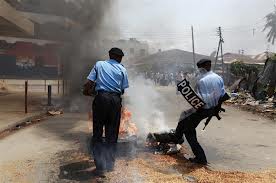
KENYA: RENEWED VIOLENCE LEADS TO FEARS OF A REPRISAL OF 2007’s DEADLY CONFLICT


Last week’s discovery by the Kenyan authorities of over 150 explosive devices in the country’s capital city of Nairobi indicates that the country’s battle against Islamic militants is far from seeing its end. Close observers of Eastern African affairs recall last year’s Kenyan incursion into Somalia aimed at deterring the Somalia-based Islamist group, al Shabaab, who were alleged to have been behind a spate of terror attacks on Kenyan soil.

Many Kenyans will probably concur with the assertion that its government’s incursion into Somalia, although well intentioned, has been counterproductive at best and its consequences disastrous at worst. The incursion has also resulted in conflict between the country’s Christian and Muslim populations and the recent discovery of explosives will no doubt further compound the distrust between members of both communities.

Tensions were stoked even further last week following the arrest of the Muslim cleric, Abubaker Sharif for his part in inciting violence in the country’s second biggest city Mombasa which led to the deaths of five people. Sharif, a divisive figure who has previous form when it comes to incitement, is alleged to have called on his followers to eliminate senior Islamic figures adjudged to have collaborated with the government, to burn churches and attack police officers.

The spiralling conflict with al Shabaab comes against the background of alarming sectarian violence in Kenya’s coastal regions which have been linked to disputes over resources between pastoralists and settled farmers. Last week’s clashes resulted in the deaths of 11 people and occurred in spite of calls from the country’s leaders, including that of its Prime Minister Raila Odinga, for an end to the violence. Of concern is that the parallel conflicts have the potential to morph into the violent scenes which followed from Kenya’s last presidential elections in December 2007 which led to the deaths of over 1,200 people.

Whilst the government’s attempts to quash the scourge presented by Islamic militants by sanctioning the military exercise in Somalia has been referred to by many as constituting the origin of the present conflict, it is well worth adding that identifying the root cause of the latest violent scenes may not be as simplistic as some would like to think. As was the case in the bloody violence which occurred half a decade ago the fight for limited resources is a major factor and element in this troubling equation which must not be discounted.

Muslim communities who outnumber their Christian contemporaries in the country’s coastal regions complain rather vociferously about losing jobs and land to members of the Christian communities. Adding to these are issues to do with unemployment mostly amongst members of the Muslim community thereby increasing the potential of the radicalisation of youth who feel marginalised and in some cases are reported to have been recruited by the al Shabaab Islamic militia in their battle against the Kenyan government. Perhaps the only certainty in this otherwise uncertain circumstance is that there will be no end to the Kenyan crises until its government adopts a multifaceted approach in confronting its problems as opposed to its current one dimensional modus operandi which fails to address the underlying social, political and economic problems facing its people.

Sunday, 17 June 2012

WAR-AFFLICTED SUDAN AND SOUTH SUDAN IN LAST CHANCE SALOON


After months of what one can only term as the ‘digging in of heels’ of the respective parties involved in the bloody dispute, it came as a shock to most observers when the Sudanese government this week revealed that it was now ready to resume talks with South Sudan.


Origins of the Dispute

Observers recall that the present conflict stems from a border dispute between both countries which arose in April of this year. Subsequent talks engineered by the African Union unsurprisingly failed to yield the desired results due to both sides’ entrenched positions. The crux of the matter was essentially a ‘minor’ – in the grand scheme of things – disagreement as to how and where the demilitarised buffer zone was to be erected.

Whilst attempting to avoid accusations of being pessimistic, one cannot help but raise the rather valid point that if the above disagreement was sufficient in itself to halt negotiations, it is in turn overly difficult to countenance how both parties will be able to resolve other issues which have also been thrown into the mix. Both countries are at loggerheads over oil export fees as South Sudan heavily depends on Sudan for exporting oil. Further, there are accusations made by both sides regarding the other’s association or rather affiliation with armed gangs who carry out raids on each other’s territory as well as additional disputes in relation to ownership of oil producing border regions.


The United Nations Involvement

The conflict has inevitably resulted in further unnecessary loss of life which is in addition to the about 2 million lives lost during the civil war between the north and south in the period of 1955 to 2005. The UN, for all the mostly deserved criticisms levelled at it in recent times, has been swift to act on this rare occasion. The Security Council’s May 2 resolution has widely been credited for preventing further escalation of the conflict between both nations. Susan Rice, the U.S. Ambassador to the United Nations acknowledged as such in declaring that the conflict between both the Sudan and South Sudan was “in a better place” than was the case prior to the authorisation of the resolution.


Humanitarian Crises

In respect of the humanitarian crises which arose in the South Kordofan and Blue Nile regions which appear to be the most affected areas owing to the conflict, she stated: "What we are seeing in terms of those refugees who have made it across the border is absolutely alarming. Those are the healthy ones, comparatively, that are able to make it out…this is indeed an exceedingly worryingly situation.” She continued, "There has been no progress in terms of the government of Sudan allowing open humanitarian access, including into rebel areas."


South Sudan and its Chequered History

South Sudan has had a rather chequered history since it attained independent status last July, thus becoming the world’s newest country. Aside the war with its more illustrious neighbour, South Sudanese government officials are battling allegations of chronic corruption made by its President, Salva Kiir. The embezzlement of public funds has been blamed for the little to no evidence of State development since it succeeded in seceding from its parent country, the Sudan. This has led to the country’s president issuing an unprecedented public call, by way of a letter, for the return of public monies. In the letter to current and former government officials dated 3rd May, Mr Kiir stated: "An estimated $4 billion are unaccounted for or, simply put, stolen by former and current officials, as well as corrupt individuals with close ties to government officials."


Sound-off

Whether next week’s meeting between both countries will be successful at achieving a cessation of hostilities is anyone’s guess. What appears to be clear however is that the said meeting probably presents the last opportunity for the resolution of matters via dialogue before full scale violence engulfs this war-afflicted region of the world.

Monday, 12 March 2012

GLOBAL PERSONALITY OF THE WEEK


Dr Atar Adaha Evans is 1worldinternational’s global personality of the week for his work in one of the most tempestuous regions of the world.

The border region between Sudan and South Sudan has long been the scene of conflict for as long as one can recall. Global affairs observers will note that the Sudan is a country which has been embroiled in conflict since 1956 with an estimated 2m people losing their lives as a result in that time.

Aid agencies have not been immune to bombing and shelling which has seen many of the agencies leave the country. Dr Evans has however stayed behind and equipped with a solitary ambulance and also under the hail of enemy fire, attended the dying and injured caught up in the conflict.

Understandably, his family have vociferously objected to his vocation due to the dangers he faces on a daily basis. Asked by the BBC who he specifically treats on the frontline, Dr Evans responded “anyone who is desperate…civilians, rebels, troops, prisoners of war. During Sudan’s last war I even treated government army officers. They continue to write me”.

1worldinternational salutes Dr Evans as one of the few remaining modern day heroes.