Showing posts with label South Sudan. Show all posts

Sunday, 14 April 2013

SUDAN AND SOUTH SUDAN: LEADERS PROMISE END TO LONG-RUNNING CONFLICT

Amidst the pervading doom and gloom atmosphere generated by the Syrian, Congolese and Middle East conflicts and the corrosive rhetoric emanating from North Korea and the likes of Iran, the Sudanese and South Sudanese governments have somehow colluded to contrive an unlikely silver lining.
 
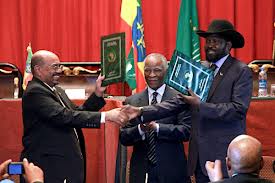
It no doubt came as a surprise to many when the government of Sudan announced that its leader, the ICC-indicted President Omar al-Bashir was to make a visit to neighbouring South Sudan, a country which split from the Sudan in 2011 following independence and with whom they have been engaged in conflict since the aforementioned split. It was even more of a surprise when President al-Bashir followed through on his promise by visiting South Sudan in the past week. The visit signals a softening and warming in relations between both countries who until 2011 had been engaged in conflict which claimed the lives of an estimated two million people.
 
Recent conflict between both nations was the result of disputes over the ownership of oil rich regions bordering the countries. The dispute threatened to plunge the region into anarchy, a state from which it has hardly recovered following decades of fighting, but for the inspired intervention of the much maligned African Union (AU) who stepped in in time to prevent the escalation of hostilities. A demilitarised zone, akin to that in place in the Korean peninsula, established in March of this year is the legacy of the recent conflict.

Whether the pleasantries and niceties exchanged between both countries’ leaders at last week’s meeting will become a permanent feature of their relationship largely remains to be seen although if their leaders’ statements are anything to be relied upon then one may well surmise that a new dawn is set to spring upon the North African terrain. For his part, al-Bashir proffered, “We won’t go back to war. President (Salva) Kiir and I agreed that the war was too long.” His counterpart Kiir, also accepted an invitation to pay al-Bashir a return visit.

It is to the credit of both nations and the AU that the threat of war has seemingly been extinguished, albeit temporarily. The symbiotic relationship between both is however one which has been overlooked as constituting a catalyst for the improvement in relations between the countries. The production of oil, a resource which accounts for a substantial part of both countries’ economies, virtually ceased almost throughout 2012 and which, as expected, has had a devastating impact on their economies. For all the ills associated with oil, human rights abuses, totalitarian regimes, rouge states et al, oil, for once, should be given credit for perhaps saving the lives of innocent civilians who would no doubt have become engulfed in another senseless conflict. Both countries’ fortunes, like that of twins, are inextricably linked and as such their leaders, Kiir and al-Bashir, will do well to heed the mantra “together we stand and divided we fall”, as only then will the cessation of hostilities be rooted in permanence.

Sunday, 1 July 2012

SUDAN: THE ARAB SPRING’S LATEST VICTIM?


Protests continued in the North African country of Sudan in the past week leading observers to pronounce that the Arab Spring may be about to claim another victim being the Sudanese Government.

The protests began about two weeks ago following the Government’s imposition of harsh austerity measures which have seen the average man on the street and the most ardent of the government’s supporters raise their voices in protest. The Government’s hands have somewhat been forced by its conflict with neighbouring South Sudan – developments in this regard have been addressed extensively by 1worldinternational – which has resulted in a significant drop in its oil revenue in a country where oil is the main source of revenue.

Both countries have been in a state of ‘semi-war’ over the last few months following a disagreement over oil export fees which Sudan expected to receive from South Sudan for transporting oil via pipeline laid in the Sudan. South Sudan subsequently shut down all oil production which has severely paralysed both countries’ economies since January. In addition, spiralling inflation rates for food and goods have also exacerbated matters in the Sudan and this is expected to worsen in the coming weeks and months. Also, sanctions imposed by the U.S government and corruption have compounded the worsening economic crisis.

The country’s Finance Minister Ali Mahmoud has shot down any hopes that the austerity measures could be reversed by asserting that it was imperative that the nation’s $2.4bn deficit was redressed. In a press conference with the media last week Mahmoud stated: “If international oil prices go up, we'll increase fuel prices. We will not retreat from the decision to lift the subsidies."

As expected, the President Omar Hassan al-Bashir-led government’s response has so far replicated that of regimes ousted by mass revolt during the Arab Spring. The use of teargas and the might of the Police have so far been employed in order to quell the protests. Several activists have also been arrested including the leaders of human rights groups and senior members of opposition parties. The protests, which initially originated in mosques and university campuses located in the Sudanese capital city of Khartoum, has worryingly for the government spread to regional cities.

Al-Bashir who has headed the ruling National Congress Party since 1989 has unsurprisingly batted away suggestions that his government may be toppled by the populist fervour which has seen to the recent overthrow of governments in North Africa and the Middle East. Al-Bashir, who has also been indicted by the International Criminal Court (ICC) on counts of war crimes and crimes against humanity in Darfur, has labelled the protesters as enemies of the nation and called for the country’s citizens to resist the protesters’ calls for revolt.

Although protests of this scale against the government are unprecedented, observers generally do not consider that the current protests have the capacity to morph into anything similar to those which toppled the Tunisian, Libyan and Egyptian governments amongst others. Needless to say stranger things have happened and the said observers, one is certain, will happily eat their words if the reverse proves to be the case.

Sunday, 17 June 2012

WAR-AFFLICTED SUDAN AND SOUTH SUDAN IN LAST CHANCE SALOON


After months of what one can only term as the ‘digging in of heels’ of the respective parties involved in the bloody dispute, it came as a shock to most observers when the Sudanese government this week revealed that it was now ready to resume talks with South Sudan.


Origins of the Dispute

Observers recall that the present conflict stems from a border dispute between both countries which arose in April of this year. Subsequent talks engineered by the African Union unsurprisingly failed to yield the desired results due to both sides’ entrenched positions. The crux of the matter was essentially a ‘minor’ – in the grand scheme of things – disagreement as to how and where the demilitarised buffer zone was to be erected.

Whilst attempting to avoid accusations of being pessimistic, one cannot help but raise the rather valid point that if the above disagreement was sufficient in itself to halt negotiations, it is in turn overly difficult to countenance how both parties will be able to resolve other issues which have also been thrown into the mix. Both countries are at loggerheads over oil export fees as South Sudan heavily depends on Sudan for exporting oil. Further, there are accusations made by both sides regarding the other’s association or rather affiliation with armed gangs who carry out raids on each other’s territory as well as additional disputes in relation to ownership of oil producing border regions.


The United Nations Involvement

The conflict has inevitably resulted in further unnecessary loss of life which is in addition to the about 2 million lives lost during the civil war between the north and south in the period of 1955 to 2005. The UN, for all the mostly deserved criticisms levelled at it in recent times, has been swift to act on this rare occasion. The Security Council’s May 2 resolution has widely been credited for preventing further escalation of the conflict between both nations. Susan Rice, the U.S. Ambassador to the United Nations acknowledged as such in declaring that the conflict between both the Sudan and South Sudan was “in a better place” than was the case prior to the authorisation of the resolution.


Humanitarian Crises

In respect of the humanitarian crises which arose in the South Kordofan and Blue Nile regions which appear to be the most affected areas owing to the conflict, she stated: "What we are seeing in terms of those refugees who have made it across the border is absolutely alarming. Those are the healthy ones, comparatively, that are able to make it out…this is indeed an exceedingly worryingly situation.” She continued, "There has been no progress in terms of the government of Sudan allowing open humanitarian access, including into rebel areas."


South Sudan and its Chequered History

South Sudan has had a rather chequered history since it attained independent status last July, thus becoming the world’s newest country. Aside the war with its more illustrious neighbour, South Sudanese government officials are battling allegations of chronic corruption made by its President, Salva Kiir. The embezzlement of public funds has been blamed for the little to no evidence of State development since it succeeded in seceding from its parent country, the Sudan. This has led to the country’s president issuing an unprecedented public call, by way of a letter, for the return of public monies. In the letter to current and former government officials dated 3rd May, Mr Kiir stated: "An estimated $4 billion are unaccounted for or, simply put, stolen by former and current officials, as well as corrupt individuals with close ties to government officials."


Sound-off

Whether next week’s meeting between both countries will be successful at achieving a cessation of hostilities is anyone’s guess. What appears to be clear however is that the said meeting probably presents the last opportunity for the resolution of matters via dialogue before full scale violence engulfs this war-afflicted region of the world.

Monday, 12 March 2012

GLOBAL PERSONALITY OF THE WEEK


Dr Atar Adaha Evans is 1worldinternational’s global personality of the week for his work in one of the most tempestuous regions of the world.

The border region between Sudan and South Sudan has long been the scene of conflict for as long as one can recall. Global affairs observers will note that the Sudan is a country which has been embroiled in conflict since 1956 with an estimated 2m people losing their lives as a result in that time.

Aid agencies have not been immune to bombing and shelling which has seen many of the agencies leave the country. Dr Evans has however stayed behind and equipped with a solitary ambulance and also under the hail of enemy fire, attended the dying and injured caught up in the conflict.

Understandably, his family have vociferously objected to his vocation due to the dangers he faces on a daily basis. Asked by the BBC who he specifically treats on the frontline, Dr Evans responded “anyone who is desperate…civilians, rebels, troops, prisoners of war. During Sudan’s last war I even treated government army officers. They continue to write me”.

1worldinternational salutes Dr Evans as one of the few remaining modern day heroes.

Friday, 30 December 2011

2011 NEWS STORIES OF THE YEAR AND ONES TO WATCH IN 2012


Today, 1worldinternational compiles and publishes its list of the most newsworthy stories of 2011 and predictions of 2012’s expected headlines. In no particular order, the following countries provided 2011’s most newsworthy stories:

1. Tunisia – The country held its first elections following the end of Zine al-Abidine Ben Ali’s twenty something year rule. Many forget that the wind of change generated by the Arab spring emanated from the self immolation of Tunisia’s Mohamed Bouazizi.

2. South Sudan – The country became the 193rd state party to the UN Charter following a referendum in which 99% voted in favour of secession from Sudan.

3. Egypt – 2011 saw the end of the reign of Hosni Mubarak’s authoritarian 30-year rule. Mr Mubarak is at present facing trial for charges of murder which carries the death penalty if found guilty.

4. Libya – The UN Security Council Resolution 1973 brought Muammar Gaddafi’s 42 year rule to an end. Unfortunately Colonel Gaddafi did not live long enough to face the law before the Courts as he met his death in what can best be described as mysterious circumstances.

5. Cote d’Ivoire – Troops loyal to the incumbent President Alassane Ouattara overpowered rival forces led by Laurent Gbagbo following a disputed election reportedly won by the former. Mr Gbagbo will face the International Criminal Court (ICC) next year.

6. Serbia – Europe’s most wanted man and Bosnian Serb, Ratko Mladic, was finally captured after years of being on the run. The phrase ‘justice delayed is not justice denied’ could not be more apt on this occasion.

7. Afghanistan – The al-Qaeda figurehead, Osama bin Laden was shot dead by American troops in Pakistan. The al-Qaeda leader was said to have been a resident of Pakistan for a while. The violence still continues thus disproving the belief that the most effective way of killing a snake is by chopping its head off.

8. Palestine – With Mahmoud Abbas at the helm furthering its cause, Palestine was granted full membership of UNESCO although his quest for independence at the UN Security Council was unsuccessful. Mr Abbas is likely to say that the UNESCO endorsement is a step further towards its goal of full recognition as a nation.

9. Yemen – Like his Tunisian, Libyan and Egyptian counterparts, the Yemeni President, Ali Abdullah Saleh’s 33-year reign came to an end in 2012. Under an agreement drafted by the Gulf Cooperation Council (GCC), Mr Saleh will formally step down from power in February/March of 2012.

10. Saudi Arabia – The unthinkable happened when King Abdullah decreed that women would for the first time have the right to vote and run in local elections from 2015.


ONES TO WATCH IN 2012


1. Afghanistan – Following President Barack Obama’s declaration, it is expected that the 33,000 US troops in Afghanistan will leave the country by mid -2012. With the level of violence being experienced by the country from insurgents at this time, President Obama may need to re-evaluate this move.

2. South Sudan – Latest clashes between the world’s newest country and its neighbour, Sudan, has the potential to escalate into a full blown conflict. Watch this space as they say.

3. Russia – Prime Minister Putin and yours truly never thought the day would come when protesters would defy threats of intimidation and the authorities to voice their displeasure over alleged rigged elections in the country. It remains to be seen whether the protests will lead to a rerun of the disputed elections or even, be the precursor to the end of Mr Putin’s presidential bid.

4. Iran – The country’s burgeoning nuclear ambitions have been frowned upon by the likes of Britain, USA and Israel. The proclamations of the Ayatollah and President Ahmedinejad have certainly not helped matters. With recent murmurings of Israeli and US joint military action, one fears we have not heard the last of this one.

5. North Korea – Kim Jong Un was named Supreme Commander following the death of his father Kim Jong Il earlier this month. Observers hope that a new course of action will be taken by the new leader in terms of its relationship with the international community. Kim Jong Un’s recent warning to South Korea and its allies that there will be no change in policy perhaps extinguishes the aforementioned hope.

6. Congo – Joseph Kabila’s disputed election victory in December 2011 led to violence, looting and destruction in this already conflict-ridden country. One of his opponents during the elections, Etienne Tshisekedi rejected the election results and proceeded to swear himself in as President. At present, there is no indication of any dialogue taking place between the parties; therefore one can only predict a continuation of the topsy turvy state of affairs which the country is now used to.

7. Iraq – 39,000 US troops were withdrawn this year after a 9-year campaign in the country which saw the overthrow of Saddam Hussein. There are real fears of sectarian violence and political impasse following the withdrawal.

8. The Middle East – Palestine, Syria, Yemen, Lebanon, Israel, Hezbollah, Hamas etc. Needless to say, there will be numerous newsworthy articles emanating from this region of the world as has always been the case.

9. China – Like Russia, few would have thought that protesters would be able to summon up courage to voice their distaste for the country’s ruling party and the endemic corruption prevalent in the nation. Will the Arab Spring spread to the Far East? One doubts it though one would have had to be a prophet to predict the downfalls of Gaddafi, Mubarak, Ben Ali and Saleh in 2011.

10. Yemen – Mr Saleh’s agreed handover date of February/March 2012 steadily approaches although this has not provided much delight to Yemenis as Mr Saleh has in the past reneged on promises made to leave power. The world watches with bated breath.
Sunday, 27 November 2011

PART 1:- HUMANITARIAN INTERVENTION: AN EVALUATION OF THE CASE FOR THE FORCIBLE REMOVAL OF REPRESSIVE REGIMES UNDER INTERNATIONAL LAW


While the notion of ‘humanitarian intervention’ was not explicitly recognised and addressed by the United Nations Charter, some have argued that the concept of international peace and security appears to have acquired meaning beyond traditional collective security, to one in which ethnic cleansing, genocide, breaches of human rights, as well as grave breaches of humanitarian law, including those encompassed within a state's own borders are considered parts of the security fabric.

This article therefore intends to examine in some detail whether contemporary international law imposes a duty on states to intervene in a third state such as Syria where mass crimes including crimes against humanity or war crimes et al are being perpetrated, although within the confines of the United Nations legal regime. The article will address this matter over two parts with the concluding part published next week.


..................................................................................................................................
INTRODUCTION

The UN General Assembly on the legality of intervention once recognised that: "No state or group of states has the right to intervene, directly or indirectly in the internal or external affairs of any other states...all forms of interference or threats against the personality of the state or against its political, economic or cultural elements are in violation of international law”. It is said that signatories to the UN Charter have delegated their right to unilateral enforcement to the UN, save on the grounds of self-defence where states are allowed to respond to the attack in the circumstances. The Security Council is thus endowed with the responsibility of undertaking executive action in order to prevent, punish a threat to or breach of the peace or act of aggression. The difficulty in ascertaining when an armed conflict constitutes or potentially constitutes a 'threat to peace and security' within the meaning of the Charter is readily apparent in many episodes that have confronted the international community since the adoption of the Charter. In the context of humanitarian intervention, the United States relied on this argument on numerous occasions over the years, most notably in Grenada and Panama. Although some identify a gradual evolution of customary international law permitting intervention by states in the event of humanitarian catastrophe, the Charter's text will undoubtedly be compromised in that event. Against this background, while the removal of, for example, the Syrian regime might be noble and ethical its legality will however be uncertain.


THE UNITED NATIONS CHARTER ON THE USE OF FORCE

Article 51 of the UN Charter which confers on individual states an 'inherent right of individual or collective self-defence' and Security Council authorised enforcement actions under Chapter VII constitute the only exceptions to Article 2(4) which prohibits 'the threat or use of force against the territorial integrity or political independence of any state, or in any other manner inconsistent with the purposes of the United Nations'. The Security Council is accorded primary responsibility for maintaining international peace and security and pursuant to Article 34 may investigate any dispute which might endanger the maintenance of international peace and security. Under Chapter VII, the Council may take any action including the use of armed force 'as may be necessary to maintain or restore international peace and security'. A determination of a threat to peace or breach of the peace made by the Security Council in response to the situations in for example, Syria or Sudan, will serve as a legitimate trigger for Chapter VII enforcement action circumventing the domestic jurisdiction clause of Article 2(7). Nevertheless, a more fundamental difficulty however will be establishing the existence of elements such as humanitarian crises or a disruption to democracy in Syria which have served as a precursor to intervention in the past, most notably in Somalia and Haiti.


THE CONCEPT OF ‘HUMANITARIAN INTERVENTION’

i. Humanitarian intervention brought about by human rights abuses

It is increasingly being accepted that the concept of international peace and security appears to have acquired meaning beyond traditional collective security (envisaged as collective response to armed attack), to one in which ethnic cleansing, genocide and other gross violations of human rights, as well as grave breaches of humanitarian law, including those encompassed within a state's own borders are considered parts of the security fabric. Humanitarian intervention was recognised in the Council's resolution which expressed demand for urgent response by the international community, determining that the magnitude of the humanitarian crises in Rwanda constituted a threat to international peace and security in the region. The Council authorised 'operations aimed at protecting displaced persons, refugees and civilians at risk, using 'all necessary means to achieve these humanitarian objectives'. Humanitarianism was reiterated in the text of Security Council resolution 688(1991) which expressed grave concern over 'the repression of Iraqi citizens leading to a massive flow of refugees towards and across international frontiers and to cross border incursions, which threaten international peace in the region', demanding Iraq to end the repression immediately. If the line of authority espoused in Iraq and Rwanda is to be followed, the displacement of a large amount of the population, who have fled Syria following the political crisis in the country, certainly presents an international crisis and consequently constitutes a 'breach of peace' which falls within the ambit of Article 39, thus requiring enforcement.


TO BE CONTINUED

Sunday, 13 November 2011

UN ACCUSES SUDAN OF ASSAULT ON SOUTH SUDAN REFUGEES


At least a dozen people of South Sudanese origin were reported dead on 11th November 2011 following the latest wave of onslaught from Sudan government forces. This latest attack follows the spate of bombings carried out by Sudan armed forces near the border separating both countries a few days earlier on 8th November 2011.

Hilde Johnson, head of UNMISS (United Nations Mission in South Sudan) confirmed that 2 bombs landed inside the Yida refugee camp and 3 outside of it. The refugee camp which suffered the attacks shelters 20,000 people in the country’s Unity State and comprises largely of individuals fleeing violence in the Sudanese states of South Kordofan and Blue Nile.

These recent skirmishes have led to fears that Africa’s longest running civil war which ended following a 2005 peace deal may be reignited. It was hoped that the independence of South Sudan, gained after many years of conflict, on 9th July 2011, would usher in a period of long sought-after stability which the region has been stranger to for generations. However, disputes over the sharing of oil revenue, the oil-rich Abyei border region and ideological differences have made the prospect of peace somewhat distant.

The UN Under Secretary-General for peacekeeping operations, Herre Ladsous briefed the UN Security Council at the end of the past week about the latest attacks, specifically highlighting the role of the Sudanese armed forces in the violence. These sentiments were echoed by the UN Human Rights chief, Navi Pillay, who has labelled the bombing of civilians an ‘international crime’ and called for an investigation into the bombing of the Yida refugee camp. The US has also voiced concerns over the safety of civilians and as a consequence has called for the cessation of hostilities in the region. “This bombing of civilians and humanitarian workers is an outrageous act, and those responsible must be held accountable for their actions”, said Jay Carney, the White House Press Secretary in a statement to the press. He continued: “The US demands the government of Sudan to halt aerial bombardments immediately”.

The latest conflict has led to the withdrawal of the British aid agency, Oxfam from the upper Nile area of South Sudan. This move is a significant blow to the refugees in the area as Oxfam is the only provider of clean water for people displaced by violence. However, the Sudanese government’s representative to the UN, Daffa-Alla Elhag Ali Osman has denied any responsibility on the part of his government for the bombings and added that its actions are aimed at rebels operating in the region. In a statement, Mr Osman stressed that the government fully respected the sovereignty and territorial integrity of South Sudan.

News of the latest attacks on civilians is no doubt troubling. Reputed press agencies, the Guardian and Voice of America recently reported findings by a US Satellite monitoring group which revealed that Sudan’s military was upgrading air bases near the border with South Sudan in order to enhance its air assault capacity. Observers worry that this is indicative of a clear intention by the government to launch a full scale aerial assault on its neighbours. President Omar al-Bashir’s government, which has been charged by the International Criminal Court (ICC) over attacks on civilians in the Darfur region of the country, is spreading itself thin in terms of its military resources, not least because of its continued operation in the Darfur region of the country, which is in addition to the operations in the South Kordofan and Blue Nile regions of the country which are allegedly aimed at engaging armed rebels based in those regions.

The protection of civilians and refugees is paramount and one hopes that the UN carries out immediately the investigation called for by Navi Pillay, the organisation’s human rights chief. An opportunity was lost by the UN and the international community to check the obduracy of the Sudanese government during the course of the Darfur conflict. Lives depend upon positive action being taken by the UN in response to these latest series of incidents. The lives of these refugees are the UN’s business.