Showing posts with label International Criminal Court (ICC). Show all posts

Thursday, 1 August 2013

WOMEN AND ARMED CONFLICT - SEXUAL VIOLENCE AS A WEAPON OF WAR

1worldinternational finally returns after a three-month hiatus with a hard hitting piece on the dangers faced by women in war zones the world over. Uche Ndaji, writer, poet and regular contributor to 1worldinternational lends her voice to this most sensitive topic.

In defence of women

Break the silence. When you witness violence against women and girls, do not sit back. Act."

Ban Ki-moon, Secretary – General

 
Rape. The most heinous of crimes: leaves in its path an indelible shame on humanity. It is too often used as a strategic military assault to terrorise a population in armed conflict yet the international community has struggled to institute robust, preventative measures for the purpose of eradicating one of the greatest scourges of warfare.


The systematic rape of 50,000 to 60,000 women in the former Yugoslavia brought rape to the forefront of international contemplation. Consequently, the International Criminal Tribunal for the Former Yugoslavia (ICTY) was the first in Europe to categorise rape as a crime against humanity and a form of torture.  Similarly, the International Criminal Tribunal for Rwanda (ICTR) emphasised rape as a vehicle through which genocide could be carried out. In the same breath, The Rome Statute of the International Criminal Court redefined the term sexual violence to encompass rape; sexual slavery; enforced prostitution and forced sterilisation, but to name a few.


Although it is unquestionable that legal frameworks exist to protect women from sexual violence in conflict, implementation falls below the yardstick set out in myriad international legal instruments. The Continuance of ‘shaking one’s finger at the problem’, excuses the preponderance of impunity. We must consider what type of solutions to offer the 102 women and girls raped by Congolese troops during the advance of the M23 rebel group in November 2012 according to UN estimations.

 
Undoubtedly, the line between violence perpetrated by non-state actors and government troops are blurred, borne out of years of guaranteed immunity, individuals have conducted barbarous crimes and continued to do so without consequences. The ‘Hidden Survivors’ report by Save the Children illustrates that out of 440 child survivors of sexual violence in the Democratic Republic of Congo, 81% of perpetrators were described as civilians and 74% as known to the survivor’s family. In the recent conflict in Cote d’Ivoire only 31% of cases of child rape were committed by armed men.


Moreover, communities are crippled by the assimilation of perpetrators of sexual and gender based violence (SGBV) who are often known to victims as neighbours, or friends. In the ICTY case of Kunarac et al. rape victims had either previously known the offender or had come across them after the war had ended. Impunity prolongs the psychological damage visited upon women and girls in conflict.

 
Administering the cruelty of sexual violence on a population instils fear, because women are often gang raped, raped with objects and forced into sexual slavery. Parties use unhinged violence to defuse resistance and demoralises the enemy. Designed to inflict discord, by fragmenting family and communal bond, groups often rape en masse in front of communities to humiliate the victim and the men who are unable to protect them.


An assault presents a cumulative chain of events for victims from: stigmatization to homelessness through to sexually transmitted diseases and unplanned pregnancies. These occurrences persist even after conflict because communities dealing with hardship and deprivation pre-war have difficulty transitioning from wartime to peacetime as a result of displacements and disintegration of the family unit.


The international community must consider what triggers such callous treatment of women and girls and a case can be made against historical and cultural values that confine the capabilities of women within certain societies which normalises discrimination and perpetuates violence. Human Rights Watch highlighted this fact in a report on post-conflict Rwanda, highlighting that “women's subordinate status in society has long subjected them to a wide array of limitations and restrictions which have discriminated against them in profound and systemic ways.” The idea that women can only be protected by the male figures in their lives encourages a sentiment of ownership which grants women an inferior status in society.
 
 
Nevertheless, it is unfair to dismiss recent developments which have put gender based violence in armed conflicts back onto the international agenda. Foreign Secretary William Hague made a declaration in The G8 Summit Foreign Minister’s meeting held in April, pledging £23 million for “sensitive and sustained support to survivors to build a case against culprits of heinous crimes.” Mr. Hague also promised “deployment of international experts to build judicial, investigative and legal capacity”. Most importantly the assurance that safe havens will be eradicated and perpetrators searched for and prosecuted regardless of nationality was welcomed with positivity by Special Representative of the Secretary-General on Sexual Violence in Conflict, Zainab Hawa Bangura. Ms. Bangura pointed out that “the Declaration of the G8 represents a beacon of light and hope for the many devastated communities in Congo, and the countless other survivors in conflicts around the world.”


Yet solving the problem requires further engagement with communities blighted by sexual violence. Encouraging community leaders to educate men and boys about the damage sexual violence causes to their society. Alex Craig from Women for Women International stressed that “The education and training WfWI provides allows SGBV survivors to achieve economic self-sufficiency through income generation activities - economic empowerment is a very powerful element of recovery and can help to mitigate and possibly prevent recurrent SGBV.”
 

Priority should be placed on extending the mandate of peacekeeping forces to protect civilians caught in the firing line of sexual violence. Furthermore, enacting stronger national and international laws will break the cycle of impunity sending a coherent message that women are not objects of war.


Sunday, 14 April 2013

SUDAN AND SOUTH SUDAN: LEADERS PROMISE END TO LONG-RUNNING CONFLICT

Amidst the pervading doom and gloom atmosphere generated by the Syrian, Congolese and Middle East conflicts and the corrosive rhetoric emanating from North Korea and the likes of Iran, the Sudanese and South Sudanese governments have somehow colluded to contrive an unlikely silver lining.
 
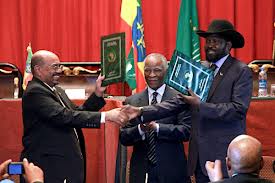
It no doubt came as a surprise to many when the government of Sudan announced that its leader, the ICC-indicted President Omar al-Bashir was to make a visit to neighbouring South Sudan, a country which split from the Sudan in 2011 following independence and with whom they have been engaged in conflict since the aforementioned split. It was even more of a surprise when President al-Bashir followed through on his promise by visiting South Sudan in the past week. The visit signals a softening and warming in relations between both countries who until 2011 had been engaged in conflict which claimed the lives of an estimated two million people.
 
Recent conflict between both nations was the result of disputes over the ownership of oil rich regions bordering the countries. The dispute threatened to plunge the region into anarchy, a state from which it has hardly recovered following decades of fighting, but for the inspired intervention of the much maligned African Union (AU) who stepped in in time to prevent the escalation of hostilities. A demilitarised zone, akin to that in place in the Korean peninsula, established in March of this year is the legacy of the recent conflict.

Whether the pleasantries and niceties exchanged between both countries’ leaders at last week’s meeting will become a permanent feature of their relationship largely remains to be seen although if their leaders’ statements are anything to be relied upon then one may well surmise that a new dawn is set to spring upon the North African terrain. For his part, al-Bashir proffered, “We won’t go back to war. President (Salva) Kiir and I agreed that the war was too long.” His counterpart Kiir, also accepted an invitation to pay al-Bashir a return visit.

It is to the credit of both nations and the AU that the threat of war has seemingly been extinguished, albeit temporarily. The symbiotic relationship between both is however one which has been overlooked as constituting a catalyst for the improvement in relations between the countries. The production of oil, a resource which accounts for a substantial part of both countries’ economies, virtually ceased almost throughout 2012 and which, as expected, has had a devastating impact on their economies. For all the ills associated with oil, human rights abuses, totalitarian regimes, rouge states et al, oil, for once, should be given credit for perhaps saving the lives of innocent civilians who would no doubt have become engulfed in another senseless conflict. Both countries’ fortunes, like that of twins, are inextricably linked and as such their leaders, Kiir and al-Bashir, will do well to heed the mantra “together we stand and divided we fall”, as only then will the cessation of hostilities be rooted in permanence.

Sunday, 1 July 2012

SUDAN: THE ARAB SPRING’S LATEST VICTIM?


Protests continued in the North African country of Sudan in the past week leading observers to pronounce that the Arab Spring may be about to claim another victim being the Sudanese Government.

The protests began about two weeks ago following the Government’s imposition of harsh austerity measures which have seen the average man on the street and the most ardent of the government’s supporters raise their voices in protest. The Government’s hands have somewhat been forced by its conflict with neighbouring South Sudan – developments in this regard have been addressed extensively by 1worldinternational – which has resulted in a significant drop in its oil revenue in a country where oil is the main source of revenue.

Both countries have been in a state of ‘semi-war’ over the last few months following a disagreement over oil export fees which Sudan expected to receive from South Sudan for transporting oil via pipeline laid in the Sudan. South Sudan subsequently shut down all oil production which has severely paralysed both countries’ economies since January. In addition, spiralling inflation rates for food and goods have also exacerbated matters in the Sudan and this is expected to worsen in the coming weeks and months. Also, sanctions imposed by the U.S government and corruption have compounded the worsening economic crisis.

The country’s Finance Minister Ali Mahmoud has shot down any hopes that the austerity measures could be reversed by asserting that it was imperative that the nation’s $2.4bn deficit was redressed. In a press conference with the media last week Mahmoud stated: “If international oil prices go up, we'll increase fuel prices. We will not retreat from the decision to lift the subsidies."

As expected, the President Omar Hassan al-Bashir-led government’s response has so far replicated that of regimes ousted by mass revolt during the Arab Spring. The use of teargas and the might of the Police have so far been employed in order to quell the protests. Several activists have also been arrested including the leaders of human rights groups and senior members of opposition parties. The protests, which initially originated in mosques and university campuses located in the Sudanese capital city of Khartoum, has worryingly for the government spread to regional cities.

Al-Bashir who has headed the ruling National Congress Party since 1989 has unsurprisingly batted away suggestions that his government may be toppled by the populist fervour which has seen to the recent overthrow of governments in North Africa and the Middle East. Al-Bashir, who has also been indicted by the International Criminal Court (ICC) on counts of war crimes and crimes against humanity in Darfur, has labelled the protesters as enemies of the nation and called for the country’s citizens to resist the protesters’ calls for revolt.

Although protests of this scale against the government are unprecedented, observers generally do not consider that the current protests have the capacity to morph into anything similar to those which toppled the Tunisian, Libyan and Egyptian governments amongst others. Needless to say stranger things have happened and the said observers, one is certain, will happily eat their words if the reverse proves to be the case.