Showing posts with label African Union (AU). Show all posts

Sunday, 14 April 2013

SUDAN AND SOUTH SUDAN: LEADERS PROMISE END TO LONG-RUNNING CONFLICT

Amidst the pervading doom and gloom atmosphere generated by the Syrian, Congolese and Middle East conflicts and the corrosive rhetoric emanating from North Korea and the likes of Iran, the Sudanese and South Sudanese governments have somehow colluded to contrive an unlikely silver lining.
 
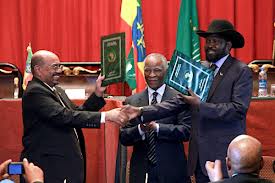
It no doubt came as a surprise to many when the government of Sudan announced that its leader, the ICC-indicted President Omar al-Bashir was to make a visit to neighbouring South Sudan, a country which split from the Sudan in 2011 following independence and with whom they have been engaged in conflict since the aforementioned split. It was even more of a surprise when President al-Bashir followed through on his promise by visiting South Sudan in the past week. The visit signals a softening and warming in relations between both countries who until 2011 had been engaged in conflict which claimed the lives of an estimated two million people.
 
Recent conflict between both nations was the result of disputes over the ownership of oil rich regions bordering the countries. The dispute threatened to plunge the region into anarchy, a state from which it has hardly recovered following decades of fighting, but for the inspired intervention of the much maligned African Union (AU) who stepped in in time to prevent the escalation of hostilities. A demilitarised zone, akin to that in place in the Korean peninsula, established in March of this year is the legacy of the recent conflict.

Whether the pleasantries and niceties exchanged between both countries’ leaders at last week’s meeting will become a permanent feature of their relationship largely remains to be seen although if their leaders’ statements are anything to be relied upon then one may well surmise that a new dawn is set to spring upon the North African terrain. For his part, al-Bashir proffered, “We won’t go back to war. President (Salva) Kiir and I agreed that the war was too long.” His counterpart Kiir, also accepted an invitation to pay al-Bashir a return visit.

It is to the credit of both nations and the AU that the threat of war has seemingly been extinguished, albeit temporarily. The symbiotic relationship between both is however one which has been overlooked as constituting a catalyst for the improvement in relations between the countries. The production of oil, a resource which accounts for a substantial part of both countries’ economies, virtually ceased almost throughout 2012 and which, as expected, has had a devastating impact on their economies. For all the ills associated with oil, human rights abuses, totalitarian regimes, rouge states et al, oil, for once, should be given credit for perhaps saving the lives of innocent civilians who would no doubt have become engulfed in another senseless conflict. Both countries’ fortunes, like that of twins, are inextricably linked and as such their leaders, Kiir and al-Bashir, will do well to heed the mantra “together we stand and divided we fall”, as only then will the cessation of hostilities be rooted in permanence.

Sunday, 25 November 2012

SIERRA LEONE: SIERRA LEONANS CHOOSE THE BALLOT OVER THE BULLET


Unsurprisingly the pattern of events which have unfolded since the outcome of national elections in Sierra Leone became known have followed a rather rancorous and familiar path. Last week’s re-election of President Ernest Bai Koroma has drawn the ire of leading figures from the country’s main opposition party who claim that the elections were flawed and rigged in favour of the incumbent. Koroma, who campaigned on the joint headers of fighting corruption and attracting investment to the country, will now serve a second term in office following his 2007 victory.

Koroma’s All People’s Congress were said to have garnered 58.7 percent of the popular vote thereby surpassing the 55 percent threshold required to claim a first round victory. The opposition party’s Julius Maada Bio of the Sierra Leone People’s Party (SLPP) questioned the validity of elections which international observers have acknowledged as being free and fair. Bio averred that the credibility of the results had been undermined by “systemic and widespread irregularities, malpractices and injustices”.

The SLPP and Bio will meet difficulties in attempting to convince anyone but their own supporters that the elections were marred by irregularities. For one, international observers including a European Union observer mission stationed in the country during the elections have had no reasons, as far as is known, to question the polls’ credibility. The EU’s presence was supplemented by observer missions from the Commonwealth, the United Nations (UN) and the African Union (AU). Further, a recount of a cross-section of the votes cast and conducted by the country’s electoral commission following the aforementioned claims of voter irregularity revealed that only a handful of the sample had been ‘contaminated’ and that the numbers of ‘contaminated’ votes were insufficient in number and scale to necessitate the annulment of the election results.

If the results of this third democratic election stand, it would signal immense progress since the end of the country’s 11-year civil war between 1991 and 2002. That unsavoury period of the country’s existence saw Sierra Leone serve as venue against the background of the commission of grave breaches of human rights and war crimes. The conflict was famous for the use of ‘blood diamonds’ by rebel soldiers to acquire ammunition, the deplorable use of child soldiers and the scores of innocent civilians now living with amputated limbs, amputation being the rebel fighters’ favoured means of intimidation and punishment. Hopes however abound that the recent elections will serve as the impetus which the country needs in order to realise the potential which the wealth of natural resources it possesses could only fuel or propel. Encouragingly early indications reveal a country so haunted by its past that its people, regardless of ethnic or political affiliation, are intent on steering its path far away from the history it attempts to dissociate therefrom.