Showing posts with label Omar al-Bashir. Show all posts

Sunday, 14 April 2013

SUDAN AND SOUTH SUDAN: LEADERS PROMISE END TO LONG-RUNNING CONFLICT

Amidst the pervading doom and gloom atmosphere generated by the Syrian, Congolese and Middle East conflicts and the corrosive rhetoric emanating from North Korea and the likes of Iran, the Sudanese and South Sudanese governments have somehow colluded to contrive an unlikely silver lining.
 
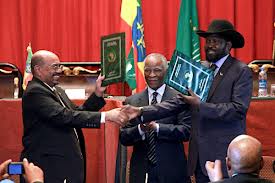
It no doubt came as a surprise to many when the government of Sudan announced that its leader, the ICC-indicted President Omar al-Bashir was to make a visit to neighbouring South Sudan, a country which split from the Sudan in 2011 following independence and with whom they have been engaged in conflict since the aforementioned split. It was even more of a surprise when President al-Bashir followed through on his promise by visiting South Sudan in the past week. The visit signals a softening and warming in relations between both countries who until 2011 had been engaged in conflict which claimed the lives of an estimated two million people.
 
Recent conflict between both nations was the result of disputes over the ownership of oil rich regions bordering the countries. The dispute threatened to plunge the region into anarchy, a state from which it has hardly recovered following decades of fighting, but for the inspired intervention of the much maligned African Union (AU) who stepped in in time to prevent the escalation of hostilities. A demilitarised zone, akin to that in place in the Korean peninsula, established in March of this year is the legacy of the recent conflict.

Whether the pleasantries and niceties exchanged between both countries’ leaders at last week’s meeting will become a permanent feature of their relationship largely remains to be seen although if their leaders’ statements are anything to be relied upon then one may well surmise that a new dawn is set to spring upon the North African terrain. For his part, al-Bashir proffered, “We won’t go back to war. President (Salva) Kiir and I agreed that the war was too long.” His counterpart Kiir, also accepted an invitation to pay al-Bashir a return visit.

It is to the credit of both nations and the AU that the threat of war has seemingly been extinguished, albeit temporarily. The symbiotic relationship between both is however one which has been overlooked as constituting a catalyst for the improvement in relations between the countries. The production of oil, a resource which accounts for a substantial part of both countries’ economies, virtually ceased almost throughout 2012 and which, as expected, has had a devastating impact on their economies. For all the ills associated with oil, human rights abuses, totalitarian regimes, rouge states et al, oil, for once, should be given credit for perhaps saving the lives of innocent civilians who would no doubt have become engulfed in another senseless conflict. Both countries’ fortunes, like that of twins, are inextricably linked and as such their leaders, Kiir and al-Bashir, will do well to heed the mantra “together we stand and divided we fall”, as only then will the cessation of hostilities be rooted in permanence.

Sunday, 13 November 2011

UN ACCUSES SUDAN OF ASSAULT ON SOUTH SUDAN REFUGEES


At least a dozen people of South Sudanese origin were reported dead on 11th November 2011 following the latest wave of onslaught from Sudan government forces. This latest attack follows the spate of bombings carried out by Sudan armed forces near the border separating both countries a few days earlier on 8th November 2011.

Hilde Johnson, head of UNMISS (United Nations Mission in South Sudan) confirmed that 2 bombs landed inside the Yida refugee camp and 3 outside of it. The refugee camp which suffered the attacks shelters 20,000 people in the country’s Unity State and comprises largely of individuals fleeing violence in the Sudanese states of South Kordofan and Blue Nile.

These recent skirmishes have led to fears that Africa’s longest running civil war which ended following a 2005 peace deal may be reignited. It was hoped that the independence of South Sudan, gained after many years of conflict, on 9th July 2011, would usher in a period of long sought-after stability which the region has been stranger to for generations. However, disputes over the sharing of oil revenue, the oil-rich Abyei border region and ideological differences have made the prospect of peace somewhat distant.

The UN Under Secretary-General for peacekeeping operations, Herre Ladsous briefed the UN Security Council at the end of the past week about the latest attacks, specifically highlighting the role of the Sudanese armed forces in the violence. These sentiments were echoed by the UN Human Rights chief, Navi Pillay, who has labelled the bombing of civilians an ‘international crime’ and called for an investigation into the bombing of the Yida refugee camp. The US has also voiced concerns over the safety of civilians and as a consequence has called for the cessation of hostilities in the region. “This bombing of civilians and humanitarian workers is an outrageous act, and those responsible must be held accountable for their actions”, said Jay Carney, the White House Press Secretary in a statement to the press. He continued: “The US demands the government of Sudan to halt aerial bombardments immediately”.

The latest conflict has led to the withdrawal of the British aid agency, Oxfam from the upper Nile area of South Sudan. This move is a significant blow to the refugees in the area as Oxfam is the only provider of clean water for people displaced by violence. However, the Sudanese government’s representative to the UN, Daffa-Alla Elhag Ali Osman has denied any responsibility on the part of his government for the bombings and added that its actions are aimed at rebels operating in the region. In a statement, Mr Osman stressed that the government fully respected the sovereignty and territorial integrity of South Sudan.

News of the latest attacks on civilians is no doubt troubling. Reputed press agencies, the Guardian and Voice of America recently reported findings by a US Satellite monitoring group which revealed that Sudan’s military was upgrading air bases near the border with South Sudan in order to enhance its air assault capacity. Observers worry that this is indicative of a clear intention by the government to launch a full scale aerial assault on its neighbours. President Omar al-Bashir’s government, which has been charged by the International Criminal Court (ICC) over attacks on civilians in the Darfur region of the country, is spreading itself thin in terms of its military resources, not least because of its continued operation in the Darfur region of the country, which is in addition to the operations in the South Kordofan and Blue Nile regions of the country which are allegedly aimed at engaging armed rebels based in those regions.

The protection of civilians and refugees is paramount and one hopes that the UN carries out immediately the investigation called for by Navi Pillay, the organisation’s human rights chief. An opportunity was lost by the UN and the international community to check the obduracy of the Sudanese government during the course of the Darfur conflict. Lives depend upon positive action being taken by the UN in response to these latest series of incidents. The lives of these refugees are the UN’s business.