Thursday, 1 August 2013

WOMEN AND ARMED CONFLICT - SEXUAL VIOLENCE AS A WEAPON OF WAR

1worldinternational finally returns after a three-month hiatus with a hard hitting piece on the dangers faced by women in war zones the world over. Uche Ndaji, writer, poet and regular contributor to 1worldinternational lends her voice to this most sensitive topic.

In defence of women

Break the silence. When you witness violence against women and girls, do not sit back. Act."

Ban Ki-moon, Secretary – General

 
Rape. The most heinous of crimes: leaves in its path an indelible shame on humanity. It is too often used as a strategic military assault to terrorise a population in armed conflict yet the international community has struggled to institute robust, preventative measures for the purpose of eradicating one of the greatest scourges of warfare.


The systematic rape of 50,000 to 60,000 women in the former Yugoslavia brought rape to the forefront of international contemplation. Consequently, the International Criminal Tribunal for the Former Yugoslavia (ICTY) was the first in Europe to categorise rape as a crime against humanity and a form of torture.  Similarly, the International Criminal Tribunal for Rwanda (ICTR) emphasised rape as a vehicle through which genocide could be carried out. In the same breath, The Rome Statute of the International Criminal Court redefined the term sexual violence to encompass rape; sexual slavery; enforced prostitution and forced sterilisation, but to name a few.


Although it is unquestionable that legal frameworks exist to protect women from sexual violence in conflict, implementation falls below the yardstick set out in myriad international legal instruments. The Continuance of ‘shaking one’s finger at the problem’, excuses the preponderance of impunity. We must consider what type of solutions to offer the 102 women and girls raped by Congolese troops during the advance of the M23 rebel group in November 2012 according to UN estimations.

 
Undoubtedly, the line between violence perpetrated by non-state actors and government troops are blurred, borne out of years of guaranteed immunity, individuals have conducted barbarous crimes and continued to do so without consequences. The ‘Hidden Survivors’ report by Save the Children illustrates that out of 440 child survivors of sexual violence in the Democratic Republic of Congo, 81% of perpetrators were described as civilians and 74% as known to the survivor’s family. In the recent conflict in Cote d’Ivoire only 31% of cases of child rape were committed by armed men.


Moreover, communities are crippled by the assimilation of perpetrators of sexual and gender based violence (SGBV) who are often known to victims as neighbours, or friends. In the ICTY case of Kunarac et al. rape victims had either previously known the offender or had come across them after the war had ended. Impunity prolongs the psychological damage visited upon women and girls in conflict.

 
Administering the cruelty of sexual violence on a population instils fear, because women are often gang raped, raped with objects and forced into sexual slavery. Parties use unhinged violence to defuse resistance and demoralises the enemy. Designed to inflict discord, by fragmenting family and communal bond, groups often rape en masse in front of communities to humiliate the victim and the men who are unable to protect them.


An assault presents a cumulative chain of events for victims from: stigmatization to homelessness through to sexually transmitted diseases and unplanned pregnancies. These occurrences persist even after conflict because communities dealing with hardship and deprivation pre-war have difficulty transitioning from wartime to peacetime as a result of displacements and disintegration of the family unit.


The international community must consider what triggers such callous treatment of women and girls and a case can be made against historical and cultural values that confine the capabilities of women within certain societies which normalises discrimination and perpetuates violence. Human Rights Watch highlighted this fact in a report on post-conflict Rwanda, highlighting that “women's subordinate status in society has long subjected them to a wide array of limitations and restrictions which have discriminated against them in profound and systemic ways.” The idea that women can only be protected by the male figures in their lives encourages a sentiment of ownership which grants women an inferior status in society.
 
 
Nevertheless, it is unfair to dismiss recent developments which have put gender based violence in armed conflicts back onto the international agenda. Foreign Secretary William Hague made a declaration in The G8 Summit Foreign Minister’s meeting held in April, pledging £23 million for “sensitive and sustained support to survivors to build a case against culprits of heinous crimes.” Mr. Hague also promised “deployment of international experts to build judicial, investigative and legal capacity”. Most importantly the assurance that safe havens will be eradicated and perpetrators searched for and prosecuted regardless of nationality was welcomed with positivity by Special Representative of the Secretary-General on Sexual Violence in Conflict, Zainab Hawa Bangura. Ms. Bangura pointed out that “the Declaration of the G8 represents a beacon of light and hope for the many devastated communities in Congo, and the countless other survivors in conflicts around the world.”


Yet solving the problem requires further engagement with communities blighted by sexual violence. Encouraging community leaders to educate men and boys about the damage sexual violence causes to their society. Alex Craig from Women for Women International stressed that “The education and training WfWI provides allows SGBV survivors to achieve economic self-sufficiency through income generation activities - economic empowerment is a very powerful element of recovery and can help to mitigate and possibly prevent recurrent SGBV.”
 

Priority should be placed on extending the mandate of peacekeeping forces to protect civilians caught in the firing line of sexual violence. Furthermore, enacting stronger national and international laws will break the cycle of impunity sending a coherent message that women are not objects of war.


Sunday, 14 April 2013

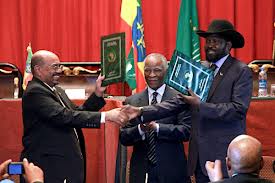
SUDAN AND SOUTH SUDAN: LEADERS PROMISE END TO LONG-RUNNING CONFLICT

Amidst the pervading doom and gloom atmosphere generated by the Syrian, Congolese and Middle East conflicts and the corrosive rhetoric emanating from North Korea and the likes of Iran, the Sudanese and South Sudanese governments have somehow colluded to contrive an unlikely silver lining.
 
It no doubt came as a surprise to many when the government of Sudan announced that its leader, the ICC-indicted President Omar al-Bashir was to make a visit to neighbouring South Sudan, a country which split from the Sudan in 2011 following independence and with whom they have been engaged in conflict since the aforementioned split. It was even more of a surprise when President al-Bashir followed through on his promise by visiting South Sudan in the past week. The visit signals a softening and warming in relations between both countries who until 2011 had been engaged in conflict which claimed the lives of an estimated two million people.
 
Recent conflict between both nations was the result of disputes over the ownership of oil rich regions bordering the countries. The dispute threatened to plunge the region into anarchy, a state from which it has hardly recovered following decades of fighting, but for the inspired intervention of the much maligned African Union (AU) who stepped in in time to prevent the escalation of hostilities. A demilitarised zone, akin to that in place in the Korean peninsula, established in March of this year is the legacy of the recent conflict.

Whether the pleasantries and niceties exchanged between both countries’ leaders at last week’s meeting will become a permanent feature of their relationship largely remains to be seen although if their leaders’ statements are anything to be relied upon then one may well surmise that a new dawn is set to spring upon the North African terrain. For his part, al-Bashir proffered, “We won’t go back to war. President (Salva) Kiir and I agreed that the war was too long.” His counterpart Kiir, also accepted an invitation to pay al-Bashir a return visit.

It is to the credit of both nations and the AU that the threat of war has seemingly been extinguished, albeit temporarily. The symbiotic relationship between both is however one which has been overlooked as constituting a catalyst for the improvement in relations between the countries. The production of oil, a resource which accounts for a substantial part of both countries’ economies, virtually ceased almost throughout 2012 and which, as expected, has had a devastating impact on their economies. For all the ills associated with oil, human rights abuses, totalitarian regimes, rouge states et al, oil, for once, should be given credit for perhaps saving the lives of innocent civilians who would no doubt have become engulfed in another senseless conflict. Both countries’ fortunes, like that of twins, are inextricably linked and as such their leaders, Kiir and al-Bashir, will do well to heed the mantra “together we stand and divided we fall”, as only then will the cessation of hostilities be rooted in permanence.

Saturday, 6 April 2013

VENEZUELA: EVEN IN DEATH, CHAVEZ’S SHADOW LOOMS LARGE


Now that the dust has settled, or to an extent settled, following the death of, for want of a better word, the behemoth of South American and perhaps global politics, Hugo Chavez, the country is now in that most perilous of situations which has confronted many a nation in the aftermath of a revolution. As tears begin to dry up and the demand for tissue paper to wipe the same off Venezuelan faces recedes, the reality of a post-Chavez Venezuela gradually dawns upon its people not least owing to the rapidly approaching election date of 14th April which seems to have snuck up on followers of South American politics with a fair degree of stealth.

While Nicolas Maduro, the Chavez-anointed acting President and favourite to bag the election attempts and fails to ape the awe inspiring persona of the late great Chavez, his rival Henrique Capriles, despite being behind in the polls, appears to be making some headway, albeit while at the same time acquiring enemies at the rate of knots in the run-up to elections.
 
Capriles’s modus operandi is one which principally consists of highlighting the numerous claims of government excesses and corruption with which its government officials are currently bedevilled. Not letting up on his attacks, perhaps having learnt a thing or two about the attack dog style of the erstwhile President Chavez, Capriles attended several rallies organised by his supporters in which he wasted no time in ‘sticking it’ to his foes. Referring to claims of endemic corruption within government circles, Capriles told the partisan crowd: “They talk of socialism, but it’s on the surface only. Look how those well-connected ones live, what they wear, what cars they go round in, how many bodyguards they have.” Ratcheting up the rhetoric, Capriles topped things off by labelling his opponents “skin-deep socialists”.
 
Whether this newly unveiled firebrand persona will be enough to see Capriles through to victory is anybody’s guess although recent polls show that Capriles’s Democratic Union Party still lag behind the ruling Socialist Party. For Capriles, the difficulty lies in convincing sufficient numbers of the electorate that the country requires a movement away from Chavez’s imbued socialist principles and ideals which has served the country’s ordinary folk so well in recent years to the centrist position which Capriles’s party advocates. While Capriles is no doubt a very able politician, he is perhaps finding that his toughest battle is not against the incumbent Maduro but against a dead man in the form of the indefatigable figure of Chavez whose ghost lurks in the background. The reality therefore is such that even if Maduro does no campaigning from today’s date until the date of the election, the groundswell of emotion following Chavez’s death is more than likely to see him through to the finish line, proving that even in death, Chavez remains the force of nature which he certainly was in lifetime.

Sunday, 24 March 2013

CENTRAL AFRICAN REPUBLIC: REBELS FINALLY OVERTHROW GOVERNMENT

Several weeks ago 1worldinternational reported on the ongoing military conflict between government forces and rebels (the Seleka rebel coalition) seeking the overthrow of the President Francois Bozize-led government (Central African Republic: Rebels Closing in on Power published on 4th January 2013). At the time it appeared as if a compromise peace deal had successfully been brokered which would see President Bozize remaining in power for a further three years and until 2016 when presidential elections are scheduled to be held in the country.
 
If early reports are to be believed, hopes of a working compromise appear have been short-lived following the rebels’ renewed attacks against the government. At the time of writing, the rebels are said to have forced their way into the country’s capital of Bangui with President Bozize fleeing the country in the process. It is as yet unclear as to why the rebels acted in breach of the peace accord agreed in January between themselves and the government although observers couldn’t assert with any confidence at the time that the peace agreement had any chance of lasting its course.

At the time of writing, news emanating from the country is that about nine South African and three Chadian soldiers were also killed by fighters linked to the rebels during the recent upheaval. The South Africans have provided military assistance to the Central African Republic government forces for sometime while Chad and the Central African Republic maintain close ties, not only because of the relationship between President Idriss Deby of the former and President Bozize of the latter since Bozize gained power by way of a coup in 2003, but also because Bozize has relied heavily on the Chadian forces’ military might in dealing with various uprisings which have become commonplace following his assumption of power.

The fall-out from the rebels’ success in the region in which the country is surrounded is expected to be of seismic proportions not least because the country’s neighbours have to some extent propped up President Bozize’s regime and have assisted militarily in attempting to extinguish the rebels. To this extent, President Idriss Deby’s Chad comes to mind. As previous experience indicates, the rebels will be most aware, if they have any sense of course, that the easy part is overthrowing governments whom they perceive to be an obstacle in their path. The difficulty arises in terms of establishing the rule of law and quelling the spates of mass disorder which inevitably follows as an after spill from the turmoil and carnage.

This tinderbox or powder-keg-like state is further exacerbated by the make-up of the rebels who, from the limited information gleaned so far, are essentially a coalition of disparate fighters. One should therefore not expect this marriage of convenience to persist until death do them part. To be fair, the Seleka forces have indicated on several occasions their intention to organise a transition towards democratic elections. Observers of Africa’s fortunes will however assert, at the risk of being labelled pessimists and perpetual killjoys, that we have heard it all before. Nevertheless, the writer will most certainly be happy to be proved wrong.

Saturday, 16 March 2013

CAMBODIA: ANOTHER MASS MURDER SUSPECT ESCAPES JUSTICE


News of the death of Ieng Sary, 87, one of the high level officials of the country’s deposed Khmer Rouge regime, has been met with a range of responses. The responses have broadly fallen into two categories with some ecstatic that Sary has now met his maker and will accordingly be judged for his hand in the pogroms committed in his time on earth and many who are disappointed that Sary will not now face justice as well as his accusers in the courts of law.

Ieng Seng served as foreign minister in the 1970s and at a time at which the country’s leadership was headed by the murderous Pol Pot whose dictatorship was responsible for the killing of between 1.7 and 2.5 million people. In the aftermath of the pogrom, the United Nations (U.N.), with the agreement of the Cambodian government, created the Khmer Rouge Tribunal, now officially referred to as the Extraordinary Chambers in the Courts of Cambodia, with the aim of trying senior and the most culpable members of the regime. The Tribunal’s processes are overseen by locally qualified and international judges working hand in hand to ensure the achievement of objectives placed within its remit, i.e. facilitating access to justice for victims of crimes against humanity, war crimes and genocide committed by the regime between April 1975 and January 1979.

Elisabeth Simmoneau Fort, a legal representative of some of the victims echoed the sentiments voiced by many that Sary’s death is a big blow to the authorities’ efforts which are aimed at bringing those responsible for the mass crimes to book. Ms Fort stated: “For the victims, this death narrows the scope of the trial and limits their search for truth and justice.” She added: “We can say that by death, Ieng Sary escapes justice.”

Sary’s death comes against the background of claims that the Cambodian government has impeded the Tribunal’s efforts by repeatedly interfering in its work and the rather shambolic conviction rates of the Tribunal constitutes, in the writer’s view, sufficient evidence to buttress this. Thus to date, only one high ranking official of the regime Kaing Guek Eav, famously known as “Duch” has been convicted for his hand in the massacres. Compounding matters further is the fact that there are only two surviving high ranking members of the regime, the majority being deceased and one having been declared mentally unfit to stand trial. With the twin evils of government interference and lack of funding impeding the process one finds it difficult to see how an ending which involves the conviction and subsequent imprisonment of those in custody will ever be achieved.

For reasons of expediency perhaps the cases should be transferred to a neutral country, possibly within the area in which Cambodia is located, appointed by the U.N. as this may rid the issue of government interference which is seen as a major stumbling block in the way of the Tribunal. While many call for increased funding of the Tribunal, one struggles to see how this would result in speeding up the process as it is the interference in the first place which has resulted in the gridlock currently being experienced by the Tribunal, and as a consequence, the Tribunal’s costs have risen accordingly. The Tribunal is clearly not short of funding, what with a reported $175 million having been spent in the five and half years from mid-2006 when it was founded to the end of last year. The writer’s sentiments are seconded by Surya Subedi, the U.N.’s special rapporteur on human rights in Cambodia in last week’s speech in Geneva, Switzerland. To sound-off, Subedi, in urging the Tribunal to exhibit some urgency in dealing with the trials, asserted: “We owe it to the surviving victims of the Khmer Rouge, the families of the victims, and the whole of Cambodian society that continues to suffer from the impact of the Khmer Rouge.” Admittedly, the writer couldn’t have highlighted the significance of the trials to the Cambodian people any better than Subedi did.

Tuesday, 5 March 2013

GUINEA: FIGHTING AND RIOTING ENGULF ANOTHER WEST AFRICAN STATE

The West African country of Guinea appears to have been struck by the curse which has afflicted its West African neighbours of late by succumbing to the political crises which has so far threatened to rip the region apart from itself. Protesters, apparently aping the Arab Spring protests, have taken to the streets over the last couple of days clamouring for the sort of change to which the region has become unfamiliar of late.
 
With the attention of regional diplomats being trained on disturbances afflicting neighbouring Chad, Mali and recently the Ivory Coast, the last thing the regional watchdog ECOWAS (the Economic Community of West African States) envisaged at this most inopportune of times was the upheaval which has emanated from Guinea and which most certainly will have the effect of encumbering its already stretched to the limit resources.
 
The protests, which started several days ago, is said to have been the result of President Alpha Conde’s failure to call for elections before the 3rd March 2013 deadline which had been set for that purpose and on which most people had relied. The said elections would have taken place on 12th May 2013. Unfortunately the waters are further muddied by the usual powder keg concoction of ethnic rivalries which when mixed with politics inevitably results in the combustion with which observers of Africa’s fortunes have become too familiar. In this vein, the protests are of added significance not least because it has now transcended mere political disagreements and appear to be a camouflage for the continued feuding between two of the country’s largest ethnic groups, the Malinke and the Peul, with the latter predominantly forming the opposition and the former currently comprising the bulk of the government’s support.
 
At the time of writing, it is reported that at least a dozen people had been killed and over a hundred had suffered injuries following the escalation of the disturbance. At least one of those reported to have lost their lives and several of the injured were said to have been caught up in a round of protests which then led to the country’s security officials opening fire on an unarmed group of protestors. Worryingly the protests, which started in the capital city of Conakry, is now said to have spread to towns located as far as over 200 miles from the epicentre of the unrest. The fact that legitimate protests have apparently been hijacked by miscreants, as has at times been reported on occasions on which there are anti-government protests, cannot be ignored.
 
The leading opposition leader, Cellou Dalein Diallo has blamed the security forces, and by implication, the President for failing to exercise control over them and for attempting to muzzle the voices of protests through intimidation. Mr Diallo asserted: “The President of the Republic has a crucial responsibility to create peace. He needs to agree to listen to others, and to respect his adversaries.” Although there appears to be no end in sight to the rapidly spreading wave of violence, the rioters will best be advised to pause for thought and gaze at their surroundings, comprising landscapes which have been blighted by the scourge of ethnic violence and bringing along with it destruction which will in turn inevitably result in a passage of time to be forever referred to as ‘the lost decades’. Perhaps a look across the horizon and onto neighbouring West African States may well help steer the fortunes of Guinea away from the quagmire into which it stares at the present moment.

Sunday, 17 February 2013

ARMENIA: NO CHANGE EXPECTED TO STATUS QUO FOLLOWING ELECTIONS

Reports suggest that no surprises should be expected from Armenian Presidential elections which are to be held tomorrow. President Serzh Sarksyan, the handpicked successor of former President Robert Kocharian, who is coming to the end of his first five-year term in power is on course to further solidify his stranglehold over Armenian politics if he gains the more than 60 per cent of the popular vote of which he has been projected by election opinion pollsters operating within the country. The 60 per cent tally, if reports are to be believed, will see Mr. Sarksyan win a greater percentage of the votes than he did in 2008.
 
The lead up to the elections has been plagued by allegations of electoral malpractice, fraud and lack of transparency in the system. The lack of confidence in the system, allied with further concerns about the credibility of the elections have inevitably led to fears of low voter turnout, the result of boycotts by eligible voters. These worries have been recognised by the Parliamentary Assembly of the Council of Europe who stated, following last month’s visit to the country, that some of the major political parties which had been “strongly expected to present Presidential candidates, chose not to do so because of their lack of trust in the conduct of the election.”
 
It would be unfair to highlight the pre-election difficulties facing the nation without noting that the country has successfully circumvented the wide scale disturbance which ensued in the course of the last Presidential elections held in February 2008. Nevertheless, recent elections have been tainted by the rather unsavoury assassination attempt on one of the election candidates, Paruyr Hayrikyan, who was shot in the shoulder on 31st January 2013. Luckily the bullet missed Mr. Hayrikyan’s vitals and he has lived to tell the proverbial tale. Further controversy and questions have also been raised about the credibility of the elections with one candidate, Arman Melikyan boycotting the election on the basis that the results had already been predetermined, and another, Andrias Ghukasyan, embarking on a hunger strike and seeking the annulment of the incumbent’s candidacy on account of alleged malpractice.
 
The country, which won independence from its parent nation the Soviet Union in 1991, has failed to live up to the promise which many believed it once possessed pre-independence with poverty and unemployment remaining rife and without any effective programmes being devised by the government to tackle these twin ills. Its economic situation has not been eased by long running conflicts with its neighbours, namely Turkey and Azerbaijan, which has in effect resulted in the imposition of economic blockades which has hampered its growth and development.
 
Its conflict with Turkey emanates from Turkey’s refusal to acknowledge allegations of genocide perpetrated by their troops against ethnic Armenians between 1915 and 1917. Armenia’s dispute with Azerbaijan on the other hand, is the result of claims over the border region of Nagorno-Karabakh. A fragile ceasefire has remained in place since 1994’s ceasefire between both nations. Against the background of both internal and external turmoil facing the nation, one hopes that next week’s election passes off peacefully and without incident. If this occurs, it may well set the country on the road to achieving the promises which many felt it held pre-independence and immediately after its independence in 1991.
 

Sunday, 10 February 2013

NIGERIA: THE FIGHT AGAINST POLIO SUFFERS SIGNIFICANT SETBACK


Worryingly, one has become rather immune to horror stories emanating from Africa’s most populous country such that news of the killing of nine health workers said to be administering polio vaccines in northern Nigeria has not come as a shock.
 

Boko Haram: The History
 
Regular visitors to the 1worldinternational weblog will be aware of the origins of Boko Haram, the terrorist group with Nigerian origins which has over the last few years masterminded attacks against the Nigerian government, public infrastructure, civilians and churches. In a previous article entitled “Boko Haram: The New Al-Qaeda?”, 1worldinternational highlighted the threat posed by the group. The article also covered fears raised by the U.S. about the Nigerian government’s inability to deal with the insurgency and the prospect that the national problem may spiral into an international concern.
 
As always, the Boko Haram Islamist sect which opposes polio vaccination programmes, for what many term the misguided reason that it is a Western-led ploy to inflict AIDS on Muslim children and cause infertility within that cross-section of the Nigerian society, have been blamed for the killings.  This week’s attack follows a similar attack against aid workers in Pakistan who had been administering polio medicine to those most prone to the disease. Police spokesman Magaji Musa explained: “Gunmen on bikes opened fire on a health centre in the Hotoro district killing seven, while an attack on the Zaria Road area of the city claimed two lives.” Musa continued: “They were working for the state government giving out polio vaccinations at the time of the attack.”
 

Blow to Worldwide Fight against Polio
 
The latest attacks on health personnel in Pakistan and Nigeria, allied with the continued threats to the lives of aid workers in these regions, is indeed a massive blow to worldwide efforts currently geared towards the eradication of the disease. In June of last year, 1worldinternational reported, in an article titled ‘Global Polio Eradication Initiative (GPEI) Declares Last Stand against Polio’, the Global Polio Eradication Initiative’s launch of an emergency action plan following fears of a resurgence of the disease in countries where the disease was thought to have been eradicated. By way of information, the GPEI was formed in 1988 and was spearheaded by the WHO, Rotary International, the United States Center for Disease Control and Prevention and UNICEF. It is also supported by polio-affected and donor governments, private foundations, development banks, humanitarian and non-governmental organizations, corporate partners and more than 20 million volunteers.
 
It is perhaps no coincidence that the countries in which the most stubborn and obdurate opposition to the administration of medicine emanates are those – Afghanistan, Pakistan and Nigeria -  in which polio remains endemic to levels needed to prevent the transmission of the disease. The December 2012 and January 2013 attacks by alleged Taliban-linked militants in Pakistan is indication of the continued lack of understanding which is required from leaders of these communities if the Ban Ki-moon led quest to “stamp out polio for good” is to be achieved in our lifetime.
 

Sound-off
 
In the circumstances, the GPEI and those leading the fight against the dissease are left with essentially three options. The first and least favoured is continuing with the same course of action, i.e. sending in aid workers against the background of the real and severe risks of attacks on their person. The second and middle of the road option entails praying and hoping that the military might of the North Atlantic Treaty Organisation (NATO), the International Security Assistance Force (ISAF) and the Nigerian government will prevail over those of the Taliban, its allies and the Boko Haram military sect. The third and most preferable option, and which in the writer’s view is most likely to yield the most dividends, is that of engaging and educating the opponents of the vaccination programme about the advantages of immunization to future generations of Muslim children. Perhaps this will, to some extent, assuage fears which manifests itself in the form of misguided views in respect of the aims and objectives of the programme.
 
In this regard, charity organisations who operate within the Islamic world such as the Red Crescent may act as mediators and/or negotiators owing to the fact that they may not face the same allegations levelled aganst Western-backed organisations and aid workers which is that they are acting as agents of the West and that they are essentially, propagating and cultivating a Western-backed agenda. Unfortunately, without the co-operation of the current opponents of the vaccination programme, who also wield such overarching power and influence over the regions in which it is most prevalent, the battle against the disease will be one with which future generations will be saddled.

Thursday, 31 January 2013

YEMEN: FATALITIES REPORTED IN STAND-OFF BETWEEN MILITANTS AND SOLDIERS

Yemeni authorities today reported that five soldiers and two al Qaeda-linked insurgents were killed in heavy fighting in the country. The insurgents, members of the militant group Ansar al-Sharia which translates as Partisans of Islamic, launched an attack against the government in 2011. The militants’ offensive achieved minimal success with the capture of two towns located in the southern part of the country.
 
Their march towards the proverbial Promised Land was however abruptly halted by reinvigorated and reenergised government forces, supported by the West, who have now reduced the sum total of the insurgent’s attacks to spasmodic or intermittent occurrences. This week’s offensive was an attempt to flush out the remnants of the militant group, and with the post-mortem of the short-lived battle due shortly, it remains to be seen whether the government’s pronouncements of victory stack up.

The Yemeni forces’ plight has not been helped by another conflict in the North-east of the country in which it is currently engaged, running concurrently with the troubles in the southern part of the country. The latest violence follows Monday’s suicide bombing attack which killed 11 Yemeni soldiers. The West and the U.S in particular has channelled considerable resources, financial and otherwise, in their attempts to forestall the march of the insurgents. The West fears that the insurgent’s success in Yemen will be used as a platform by the militants to launch attacks the world over hence its increased significance in the war against terror.
 
Often described as a failed state, and perhaps rightly so, the country’s instability has led to a power vacuum which in turn has been exploited by various al Qaeda splinter groups, all said to operate under the auspices of the Yemen-headquartered al Qaeda in the Arabian Peninsula (AQAP). With Yemen being of such strategic importance to both sides, meaning the West and Islamist militants, one therefore wonders whether Afghanistan’s tag as the ‘frontline of the war on terror’ is rather misguided.

Saturday, 26 January 2013

AZERBAIJAN: ARAB SPRING’S TENTACLES EXTEND WESTWARDS

 
Many, for good reason, wondered whether the Arabian revolution would extend across jurisdictions, or would sadly be confined within the borders of the Arab world. Alas, the questions circumventing the minds of the inquisitive, but as yet unasked, have now been answered by the unfolding of recent events in the former Soviet republic.

The country’s sleepy town of Ismailli was the scene of unprecedented violence and rioting which resulted in the destruction of public amenities, buildings and infrastructure. As was the case in the Arab world, the disturbance appears to stem from discontent about the government whom locals have lost faith in. Many feel that the country’s wealth, owing to the abundance of natural gas resources, has failed to filter down to the man on the street, but rather, remains in the hands of a few – the few being people in government or with links to the establishment. Widening inequality, poverty, unemployment and the worsening economic situation, seemingly with no end in sight, hasn’t eased the current state of play. The protesters allegedly called for the resignation of the regional governor, Nizami Alekperov, seemingly attributing the problems to him, presumably as an emanation of the state. Reports emanating from the country indicate that water canons and tear gas were employed by the authorities in order to disperse the riotous crowd.

As has come to be expected from governments in a similar position to that being currently occupied by the Azeris, a senior official was dispatched to extinguish any media-generated speculation to the effect that the Arab Spring is set to claim its next victim. That unwanted task thus fell to Ali Akhmedov, deputy chairman of the Yeni Azerbaijan party which forms the present government. Akhmedov asserted: “I don’t believe that this situation can spread to the other regions as there is no basis for that.” He continued: “There are just some destructive forces inside the country who are interested in the destabilization of the situation, but they are weak.”

Regardless of the government’s attempts to sweep the disturbance under the carpet, the riots, in a country where protests are more or less uncommon, are of significance and probably the biggest threat to the Aliyev dynasty since its assumption of power in the days of the Soviet Union. By way of a fact dissemination exercise, the incumbent is Ilham Aliyev, the son of Heydar Aliyev, who ruled the country for 10 years before being succeeded by his son in 2003. The similarities with the Arab spring don’t end there with reports of further protests being planned by those in support of the Ismailli rioters’ cause with social networking sites such as Facebook, the scourge of totalitarian states and fallen Arab leaders, being used to mobilise protesters.

Unfortunately the Azeri government has in the past shown no hesitation to use force in order to quell public disturbances and one expects the present occasion to be no different, and with elections scheduled for later this year, one anticipates the government to strong arm its people, especially its opponents, into submission. Moreover, Azerbaijan plays a rather strategic and important role in the West’s war on terror and for that reason, the US and its consigliores lack the political will to support any attempts to depose those at the helm of what is essentially the Aliyev personal fiefdom. To be blunt, the Azeri government faces no real threat until the West secures an alternative, as a military base in respect of its Afghanistan operations, to that provided by Azerbaijan. Until then, the West’s attention will remain conveniently diverted away from Azerbaijan’s dictatorial, oppressive and totalitarian regime.

Wednesday, 9 January 2013

KASHMIR: INDIA AND PAKISTAN RENEW HISTORICAL HOSTILITIES

This week has seen the renewal of hostilities between two of the Asian subcontinent’s superpowers, India and Pakistan. Both have engaged in military conflicts on three occasions since 1947 when they became independent nations and the latest skirmish, once again over the disputed Kashmir region to which both parties lay claim, threatens the relative stability to which the inhabitants of both countries have recently become accustomed.

The latest threat to the fragile peace pervading the region was allegedly instigated several days ago by Indian troops who are said to have been responsible for the death of a Pakistani soldier in the disputed region. In line with the recent breach of peace, two Indian soldiers have today been reportedly killed and mutilated in what some have referred to as a reprisal attack following from the death of the Pakistani soldier earlier this week.

Both sides have moved quickly to diffuse the potentially combustible situation by urging for calm. Salman Khurshid, India’s foreign minister said: “We cannot and must not allow the escalation of any unwholesome event like this.” He continued: “We have to be careful that forces…attempting to derail all the good work that’s been done towards normalization should not be successful.” The unexpectedly restrained sentiment was seconded by the Pakistan foreign ministry whose statement read: “Pakistan is committed to a constructive, sustained and result-oriented process of engagement with India.”

Despite the public show of unity being presented by both sides, all eyes continue to be trained towards the direction of Kashmir not least because the ‘tinderbox’ nature of the past and recent history of the region is such that an explosion is only but a matchstick away. Both countries’ possession of nuclear weapons complicates matters further as full scale conflict risks not only engulfing the whole region but the globe as a whole. While both sides have largely respected the militarized Line of Control (LoC) which has until recently been effective as a means of deflating the crisis, it is becoming apparent that a new solution, most preferably of the permanent variety, will need to be devised in due course. Perhaps with UN involvement, a line of patrol could be established with UN helmeted troops manning the same. This proposal, along with the prevailing status quo, i.e. the LoC situation, are merely but temporary solutions and undoubtedly, a long-term solution is required sooner rather than later although the present writer is admittedly at a loss as to what this measure or measures should entail.

Friday, 4 January 2013

CENTRAL AFRICAN REPUBLIC: REBELS CLOSING IN ON POWER

Happy New Year to all the readers of the weblog. It was a really successful 2012 and we hope 2013 continues in the same vein. Having taken a 3-week break at the end of 2012, 1worldinternational returns with a piece on the troubled Central African Republic whose future is precociously balanced on a precipice.
 
 
Just when one thought that the state of affairs in the West and Central parts of Africa couldn’t deteriorate any further, what with the turmoil in Mali, Nigeria and the Congo, the Central African Republic succumbed to the disease which its aforementioned neighbours have been diagnosed with.


Background

By way of a brief background to recent events, the Seleka rebel group launched its offensive against the government of President Francois Bozize who has been in power since 2003. His subsequent victories in two further elections held since then, namely in 2005 and 2011 have done nothing to boost his democratic credentials as these have unsurprisingly been mired in and discredited by claims of electoral malpractice. The rebels’ discontent lies in Bozize’s alleged mismanagement of the country’s affairs and reneging on promises made to former rebels to provide financial assistance and jobs for them. The Seleka alliance is said to be made up of a collection of several rebel groups who have seemingly heeded the message contained in the mantra: “together we stand, divided we fall”.

 
Attempts at Resolving the Conflict

Africa’s latest civil war has luckily failed to escape the attention of the international community - unlike that of the Congo and Sudan where there has been a significant lack of political will to bring the conflicts to an end - with the Africa and European Unions, France and the United States nudging the warring parties to settle their grievances through dialogue rather than bullets. A further round of talks is scheduled for 10th January with Libreville, the capital city of Gabon, providing the venue for the latest attempt at a peaceful resolution.

Unfortunately not much hope is being held out for a resolution of the conflict next week not least because the rebels are only a few miles outside of the country’s capital city of Bangui and appear to have victory within striking distance. In addition, the rebels have claimed that Bozize is prone to renege on promises and as a result, there are no guarantees that he will honour his own side of any agreement, if any is arrived at, between both sides at next week’s talks. The rebels are also almost certainly expected to insist on the resignation of President Bozize as a pre-condition for engaging fervently in the talks and at the time of writing, Bozize’s camp has flat out ruled out the rebel’s demands. President Bozize, in an interview with the Reuters news agency, via his spokesman, Cyriac Gonda stated: “The question of President Bozize leaving…will be rejected systematically if it is proposed.”

 
Sound-off

The rebels’ successes have occurred in spite of the military assistance provided by some of the country’s neighbours such as Cameroon, Gabon and Chad. This week’s plea, presumably aimed at the rebels from Bozize, urged the rebels to allow him to complete his mandate which is set to terminate in three years time. Bozize also promised that he would not participate in the country’s next presidential elections scheduled for 2016.

The significance of next week’s talks cannot be overstated due to the involvement of the country’s aforementioned neighbours as one can easily foresee a Congo-like scenario where these neighbours in tandem launch an offensive against the victorious rebels thus plunging the region into further instability. President Idriss Deby and the Republic of Chad in particular, with the most to lose from the rebel’s victory owing to their long-term support for Bozize, will no doubt be at the forefront of any such moves to forcibly remove the rebels from their seat of power. Commonsense would suggest that the rebels should allow Bozize to finish his term but if Bozize’s previous form is taken into account, i.e. reneging on promises, one can understand why the rebels fail to believe that Bozize’s word is bond.

Tuesday, 11 December 2012

PURE AS THE ENDS WE SEEK by Jim Ghedi


Jim Ghedi, the artist, writer and poet returns as guest writer on the blog with the insightful article, somewhat appropriately titled ‘Pure as the ends we seek’. His new album entitled ‘Sets of Abyssinia’, the result of a project with the singer-songwriter Neal Heppleston, is now available to the public and comes highly recommended by 1worldinternational.

 
I started to realize that as human beings we influence each other by who we are. In that sense, humanity is the most susceptible organism on earth.

This brings up an interesting concept, as being surrounded by good and positive people we will evidently be influenced to do good and positive deeds in day-to-day life. But there obviously are, in this world, an abundance of bad people with negative or selfish intentions who have the power to influence us subconsciously or indeed even consciously to do bad on this earth.

This brought to mind a continuous theme that’s existed for centuries, namely man’s constant battle between good and evil. I began to contemplate a situation, where ourselves as human beings consciously tune into goodness, positivity and love, learning from the works of great men, great composers, great authors, great artists, poets, people who committed their lives to do good for others, who sacrificed their lives for the struggle for justice and peace on earth and those who believed that the universe exists on moral foundations. Evidently the fate of the universe and the future of existence lie in our moral convictions as good human beings.

In short my realization today illustrated that previous philosophers and social thinkers through time even though well intentioned, were often misdirected, in that they observed the sufferings of the world from a materialistic point of view. For instance, Marx looked at changing or destroying states and social systems. In essence he advocated a revolution by means of brutality, when to bring true change I feel would have been much simpler than forming marched armed revolts against the state.

Imagine if more human beings awoke tomorrow morning, having simply switched perspectives and consciousness to something closer to feelings of compassion. If more people woke up with an incentive to not just be tuned in to goodness but to have a moral determination to generate positivity for the benefit of all beings in the day to come ahead of them. Imagine just by an awareness each understood the concept of this universal influence we have on each other, maybe it is all just connecting to a mental and emotional switch, where we can turn on to the prosperity of this world.

As simple as waking with a thought, to provide for something living with me today, this also creates the truth that as being consciously tuned into what’s good we must distinguish evil as well. If we continuously fall victim to this world’s distractions and fail to switch on to what’s right and what’s wrong we will not progress as a people; rather we shall fall into emptiness instead of meaning.

I realise sceptics and realists will argue that there are few who will desire the intentions of good within themselves or that people live in different circumstances and as such are unable to focus their energy towards “the good”. But I argue all human beings desire happiness and to be happy and though distracted now they must understand the only happiness they will attain will be through the goodness of what’s inside them and also what surrounds us all, in our environment, our society, our world and our universe.

Martin Luther King jr once said “the means we use, must be as pure as the ends we seek.” There is nothing quite as pure as human compassion and through that we can endure true love. We must though understand we can only achieve anything through human kind’s ability to change its own condition, nothing can be of substance without action.

Monday, 3 December 2012

THE CONGO: ARE SOME WARS LESS IMPORTANT THAN OTHERS?


This week's post comes from the writer and poet, Uche Ndaji who has produced a polemic on the fortunes, or rather misfortunes, of one of Africa's largest countries, DRC Congo. The piece adopts a multi-faceted approach in its analysis of the Congo with the author avoiding the oft-repeated patronizing tone adopted by many researchers in their attempts to channel or convey the Congo experience to the rest of the world. The piece is worth publication in the very best of the global news outlets across the world and 1worldinternational is certainly privileged to serve as the mouthpiece of this fantastic writer.


When the M23 rebel group audaciously marched into Goma on 20 November a feeling of dread emerged, an oxymoronic combination of expectation and surprise. As MONUSCO, the United Nations Organisation Stabilisation Mission in the DR Congo shockingly looked on, the M23 captured Goma with little more than agonising stares to contend with.

For the unfortunate population in eastern Congo, a sentiment of déjà vu perseveres: a feeling that a war that never ends begins once more in a conflict that has claimed 5 million lives. Where were the diplomats, the envoys and regional leaders spinning for one side or the other? Did the world leaders lose the memo? If colonial discord is put to one side for the purpose of addressing the country’s recent past, the Democratic Republic of Congo has been in turmoil since independence in 1960.

In recent times, the Congolese population have not known peace because the mineral wealth which it is blessed with including: gold, tantalum, tin, but to name a few has turned into an encumbrance. Decades of political coups d’état and unstable leadership steadily guided a country with abundant natural wealth into the hands of rapacious states.

In a letter presented on November 15 to the Security Council by the Group of Experts on the Democratic Republic of Congo, light is shed on the carefully coordinated proxy war financed by Rwanda and factions of the Ugandan government. The report emphasises the influence of the Rwandese and Ugandan governments on the conflict through arms and personnel provision. Furthermore, the report stresses the fact that M23 is the only rebel group in eastern Congo that wears Rwandan armed forces uniforms. This deals a big blow to Rwandan president Paul Kagame’s unrelenting denials of his government’s support and connection to the cause of the uprising or the M23 rebel group.

Simmering alongside allegations of Rwanda’s support for M23 are ethnic divisions which stem from Rwanda’s genocidal past and DR Congo’s safeguarding of some of the Hutu administration who devised the 1994 massacre that killed as many as 1 million people according to the United Nations Outreach Programme. In a bid to protect the Rwandan Tutsi minority and its expatriate population within Congo from attacks by Hutu militiamen operating from its border with eastern Congo, the Rwandan government has used the pretext of protecting its citizens to pillage Congo DR’s natural resources.

On one hand, criticising the international community for lack of action against a conflict that has ravaged the lives of millions seems unwarranted, perhaps unfair. On the other hand, the least the UN can do is to take action against systematic human rights abuses for the sake of the 5 million killed; 1.7 million internally displaced people and the rape victims, attacked at the rate of 48 every hour according to the American Journal of Public Health.

A recurring concern remains that warlords capture and retain territory with impunity, executing civilians, looting, raping and forcibly conscripting child soldiers. A prime example of such an aggressor is the M23 leader Bosco Ntaganda, wanted for trial by the International Criminal Court on a warrant issued in 2006 for conscripting, coordinating the recruitment and training of children under 15, as former Deputy Chief of General Staff for Military Operations for the Forces Patriotiques pour la libération du Congo (FPLC).

In light of such atrocities, there is an unpleasant impression propagated by the international community that some wars are more important than others. That if your war does not involve terrorism, extremism or a direct threat to the exportation of democracy to the developing world then it must be a trivial conflict to be tucked away into the pile of inconsequential scuffles that just happen. In such cases few resolutions are made except for squabbling between Security Council members, who doubt the motives of intervention even when civilians are trapped in the savageries of warfare: the conflict in Syria comes to mind.

Consider if the fanfare surrounding the recent Israel-Gaza hostilities had been applied to the DR Congo conflict, much progress would have been made bearing in mind that it is in poor taste to compare wars. In the same breath, restrained indifference encourages belligerent forces to continue brutalising villages. The recent UN report also called attention to the slaughter of hundreds of civilians in North Kivu under the instructions of M23, with at least 800 houses burnt down since May 2012.

Although the UN peacekeeping mission MONUSCO costs an estimated $1 billion a year, its function is yet to be realised. Established in 1999, the mission has done little to prevent widespread killings and rapes in the eastern region of Congo. The purpose of the peacekeeping mission was further called into question when UN personnel stood and watched as rebels took the city of Goma. The frequency of such incursions tells the dismal story of a failed mission but more importantly the innocent Congolese people caught in the middle of MONUSCO’s spineless assignment, leaving civilians to protect themselves.

The $1 billion spent on a protective force that appears futile can be used to prop up the projects of rape victims who assist other victims by providing shelter, medical and psychological care.

Meanwhile, the rebels are aware that the UN mission has run its course, the daring march into Goma emphasises this point and the exasperation of the angry crowd that clapped for the rebels and hurled stones at UN troops is an indication of accepted apathy. The international community must do something to restore confidence, it should either extend MONUSCO’s mandate or create a different structure, active in engaging when rebels show aggression towards civilians.

Also, it is essential to initiate dialogue between the governments of Rwanda, Uganda and DR Congo. These governments are culpable on some level of arming rebel groups. Perhaps Rwandan and Ugandan governments realise that if the war rages on in Congo they can appropriate more minerals and assure that the status quo of their regimes remain. However, the unpredictability of constant change in leadership and blocs in the respective rebel groups operating in DR Congo shows that nothing is guaranteed.

Despite the announcement on 30 November by International Development Secretary Justine Greening that £21m worth of aid to Rwanda would be withdrawn, it remains to be seen how responsive the Rwandan government and their Ugandan counterparts can be in ensuring that peace finally reigns in DR Congo.


Sunday, 25 November 2012

SIERRA LEONE: SIERRA LEONANS CHOOSE THE BALLOT OVER THE BULLET


Unsurprisingly the pattern of events which have unfolded since the outcome of national elections in Sierra Leone became known have followed a rather rancorous and familiar path. Last week’s re-election of President Ernest Bai Koroma has drawn the ire of leading figures from the country’s main opposition party who claim that the elections were flawed and rigged in favour of the incumbent. Koroma, who campaigned on the joint headers of fighting corruption and attracting investment to the country, will now serve a second term in office following his 2007 victory.

Koroma’s All People’s Congress were said to have garnered 58.7 percent of the popular vote thereby surpassing the 55 percent threshold required to claim a first round victory. The opposition party’s Julius Maada Bio of the Sierra Leone People’s Party (SLPP) questioned the validity of elections which international observers have acknowledged as being free and fair. Bio averred that the credibility of the results had been undermined by “systemic and widespread irregularities, malpractices and injustices”.

The SLPP and Bio will meet difficulties in attempting to convince anyone but their own supporters that the elections were marred by irregularities. For one, international observers including a European Union observer mission stationed in the country during the elections have had no reasons, as far as is known, to question the polls’ credibility. The EU’s presence was supplemented by observer missions from the Commonwealth, the United Nations (UN) and the African Union (AU). Further, a recount of a cross-section of the votes cast and conducted by the country’s electoral commission following the aforementioned claims of voter irregularity revealed that only a handful of the sample had been ‘contaminated’ and that the numbers of ‘contaminated’ votes were insufficient in number and scale to necessitate the annulment of the election results.

If the results of this third democratic election stand, it would signal immense progress since the end of the country’s 11-year civil war between 1991 and 2002. That unsavoury period of the country’s existence saw Sierra Leone serve as venue against the background of the commission of grave breaches of human rights and war crimes. The conflict was famous for the use of ‘blood diamonds’ by rebel soldiers to acquire ammunition, the deplorable use of child soldiers and the scores of innocent civilians now living with amputated limbs, amputation being the rebel fighters’ favoured means of intimidation and punishment. Hopes however abound that the recent elections will serve as the impetus which the country needs in order to realise the potential which the wealth of natural resources it possesses could only fuel or propel. Encouragingly early indications reveal a country so haunted by its past that its people, regardless of ethnic or political affiliation, are intent on steering its path far away from the history it attempts to dissociate therefrom.

Monday, 12 November 2012

IRAN: INTERNATIONAL ATOMIC ENERGY AGENCY AND IRAN AGREE TALKS


News of Iran’s imminent return to the negotiating table has allayed concerns of further instability in the Middle East. The talks, which are being forced through by the International Atomic Energy Agency (IAEA), are expected to take place on December 13 in the country’s capital, Tehran. The talks are being held side by side with separate discussions involving Germany, France, Britain, China, Russia and the United States, and are also aimed at defusing the rather complex Middle East powder keg.

The IAEA’s attempts to inject some calm to the tense proceedings have so far been met by strong Iranian resistance. Iran continues to assert that its nuclear intentions are pure and that its purpose for acquiring nuclear capability is non-military. Iran’s return to the negotiating table has surprisingly been met with anything but elation and optimism which most certainly owes to the fact that too many proclamations of a ‘new dawn’ have been sounded out in the past but without progress on the ground commensurate with previous shades of optimism. Dare I say that the present debacle is rather akin to the parable of ‘the boy who cried wolf’.

Matters are not made any easier by the country’s leader Mahmoud Ahmadinejad who appears to revel in the attention directed by the international media towards his region of the world, albeit for the wrong reasons. Needless to say his latest pronouncements that “the Iranian nation is not seeking an atomic bomb, nor do they need to build an atomic bond” was not only met with silence which it deserved but also derision. To many, Ahmadinejad will continue to fail in his attempts to pull the wool over the watching world’s eyes if he, on the one hand states that the country’s nuclear enrichment programme is geared towards peaceful aims, but at the same time, prevents the IAEA from visiting alleged nuclear enrichment sites and also, continues to threaten the state of Israel, for all their faults, with eternal damnation.

The restrained pronouncements in light of the latest developments by leading global figures perhaps tells its own story and buttresses the writer’s earlier assertions. Catherine Ashton, the Foreign Policy supremo of the European Union cautiously asserted that the talks “could be an initial step on the path to resolving outstanding issues.” The United States, via its State Department Spokeswoman, Victoria Nuland, offered: “In the past Iran has been unwilling to do what it needs to do despite the best efforts of the IAEA. But we commend the IAEA for keeping at it and we call on Iran to do what it needs to do to meet the international community’s concerns.”

The announcement comes a week after the Pentagon reported that Iran had fired at an unarmed American drone thereby risking an international incident with the capacity to morph into a major conflict. Nonetheless and in spite of the air of pessimism which pervades, the agreement to return to the table is encouraging and signals a climb down from the ‘chest puffing’ which the conflict’s main protagonists – Iran, Israel and the United States – have so far been engaged. Liberals will argue that the sanctions regime has been effective at forcing Iran to utilise diplomatic channels to resolve the dispute while ‘hawkish Republicans’ and Benjamin Netanyahu’s – the Israeli President - supporters will state that Iran is utilising the talks as a smokescreen whilst it completes its nuclear programme. Although President Obama’s victory most certainly means that the United States will only engage militarily against Iran as a last resort, the writer however believes the threat of an Israeli pre-emptive strike still looms large and has not been allayed by Iran’s sudden and unexpected move.

Sunday, 4 November 2012

SRI LANKA: U.N. HUMAN RIGHTS COUNCIL URGES GOVERNMENT TO INVESTIGATE WAR CRIMES


The global human rights watchdog the United Nations Human Rights Council this week pressed the Sri Lankan government to bring to book those implicated in the commission of war crimes and the violation of human rights during the course of the country’s 30-year long civil war. The allegations principally centre on the state of chaos which prevailed in the period towards the end of the civil war during which army personnel were said to have wantonly carried out mass crimes against Tamil civilians in their fight against Tamil Tiger rebels.


Extra-judicial killings, Freedom of Expression and Disappearances

Speaking in the aftermath of the Council’s latest meeting, the U.K’s ambassador Karen Pearce made reference to allegations that lawyers, activists and journalists who have dared to highlight continuing violations of human rights have faced persecution from the authorities. Mrs Pearce urged the Sri Lankan government to ensure the discontinuance of “reprisal attacks against any individual including for cooperating with U.N. mechanisms”. In adding her own two cents to the debate, the U.S. ambassador Eileen Donahoe revealed the unfortunate truths that threats to freedom of expression, disappearances and extra-judicial killings still exist in the post-war Sri Lanka. Addressing the alleged violations of human rights and international law, Mrs Donahoe stated that Sri Lanka needed to “end impunity for human rights violations and fulfil legal obligations regarding accountability by initiating independent and transparent investigations”.


Government Denials

As expected, the latest developments have been met with concrete denials by the Sri Lankan government as has been the case since the allegations first surfaced at the end of the war about three years ago. The special envoy of the President on human rights matters, Mahinda Samarasinghe said that his country was taking matters seriously as evidenced by the fact that the country’s courts were already investigating crimes committed against civilians during the war. Samarasinghe referred to the country’s Lessons Learnt and Reconciliation Commission (LLRC), akin to South Africa’s Truth and Reconciliation Commission, which has played a significant role in the country’s healing process following the war. To this end Samarasinghe averred: “Protection of civilian life was a key factor in the formulation of government policy for carrying out military operations and the deliberate targeting of civilians formed no part in that strategy…If reliable evidence is available in respect of any contravention of the law, the domestic legal process will be set in motion.”


Report of the International Commission of Jurists (ICJ)

Try as it may the Sri Lankan government’s protestations have not been persuasive enough to shake off the claims. The contents of the recent report of the International Commission of Jurists (ICJ) titled “Authority without Accountability: The Crisis of Impunity in Sri Lanka” provided a damning indictment of the government’s efforts to bring the alleged perpetrators of the crimes to book. The report accused the government of President Mahinda Rajapaksa of being in serious breach of its international obligations to protect and promote human rights by purposefully failing to bring to justice the alleged criminals. The ICJ also highlighted evidence of intimidation of members of the judiciary, media and human rights groups who have shouldered responsibility for bringing the said criminals to book in the absence of effective and coordinated government action.


Sound-off

Long-term observers of political affairs relating to the Asian sub-continent will agree that the Sri Lankan government is currently in denial and could have achieved more than it currently has in terms of bringing the key protagonists in the country’s darkest period to book. Its recent actions are also at odds with its persistent pronouncements of innocence. This week the President instigated a motion in parliament aimed at the removal of the chief justice, Shirani Bandaranayake. At the time of writing no reason has been provided for the move although some claim that it is evidence of the campaign of intimidation which awaits individuals who fail to toe the government line. Rajapaksa should best beware that the eyes of the international community are, from this point on, permanently trained upon him and its stares will not be diverted until the subject of accountability is nudged towards the crest of his political agenda.

Monday, 29 October 2012

MALI: ALGERIA’S AGREEMENT PAVES THE WAY FOR MILITARY INTERVENTION


The last few months have seen numerous developments take place in the West African country of Mali. So numerous have these changes been that news outlets have struggled to keep apace with the rapidly transcending circumstances. This week, Algeria, said to be the only obstacle to an ECOWAS-led military intervention in Mali, approved an intervention, the consequences of which have the potential to spill into its territory.


ECOWAS’s (The Economic Community of West African States) aim, by way of the intended action is to wrestle back control from al Qaeda-backed militants of the northern part of the country which for several months, has been outside the control of the country’s government. Some reports now claim that Tuareg rebels, working in tandem with al Qaeda-supported Islamist militants now control two thirds of the country since army generals instigated a coup in March of this year.


Algeria’s agreement hasn’t been achieved without the usual diplomatic arm twisting. In this case, its colonial father France has been at the forefront of efforts to acquire Algeria’s approval prior to the intended intervention. It would now appear that France has been able to assuage the fears of Algeria, a country with growing influence in the region, of fears that the conflict would spill into its territory and further fears over the likely duration of the conflict. This latest development follows the recent U.N. Security Council resolution whose central proposal was its urging of African states and the United Nations for the production of an intervention plan in Mali.


In the same week the African Union (AU) lifted its suspension of Mali which was imposed on the country following the aforementioned coup d’etat which unseated President Amadou Toumani Toure earlier on in the year. The country’s Foreign Minister Tieman Coulibaly attributed the lifting of the sanctions to Mali’s “respect of signed agreements and the creation of a government of national union conforming to the demands of the international community.” One of the conditions for the intervention is rumoured to be that elections would have to be held within 12 months after the return to ‘constitutional order’.


It is worthwhile noting that international consensus has been achieved with regard to how the Malian situation should be addressed. Germany, by way of its Foreign Minister Guido Westerwelle averred in the past week that the European Union must assist with the African-led Mali mission. France’s position is visibly clear having seized the reins in the drafting of an intervention centred U.N. resolution and selling the idea of intervention to a very reluctant Algeria.


The U.S., via its Defence Secretary Leon Panetta, highlighted the gains made by al Qaeda which has successfully exploited the power vacuum in the region and the need for the international community to work hand in hand in order to deal with the threats. Panetta stated: “We need to work with the nations in the region. They all agree that we are facing the same threat there from AQIM (said to be al Qaeda’s branch in North Africa). He continued: “Our goal right now is to try to do everything we can to bring those countries together in a common effort to go after AQIM.”


Even if the AU can produce the detailed plan for intervention requested by the U.N. Security Council within six weeks of October 12, uncertainty still pervades as to whether military action will commence in the immediate aftermath or after a further, and as yet unknown, time limit has elapsed. If last week’s statements by the Chairwoman of the AU, Nkosazana Dlamina-Zuma, are to be believed then the former might well be the case. To this end, Dlamina-Zuma stated, in the course of interviews with global news outlets: “We are working to finalise the joint planning for the early deployment of an African-led international military force to help Mali recover the occupied territories in the North.” At the same time she revealed that the AU was set to “leave the door of dialogue open to those Malian rebel groups willing to negotiate.”


Realists will acknowledge that the chances of resolution of the conflict at this late stage by way of dialogue are slim at best and negligible at worst. The AU and UN must pay heed to the fact that the slightest signs of failure of this most surreptitious of plans will inevitably lead to scribes reaching for their pens in order to draw parallels between the present scenario and Afghanistan.