Sunday, 14 April 2013

SUDAN AND SOUTH SUDAN: LEADERS PROMISE END TO LONG-RUNNING CONFLICT

Amidst the pervading doom and gloom atmosphere generated by the Syrian, Congolese and Middle East conflicts and the corrosive rhetoric emanating from North Korea and the likes of Iran, the Sudanese and South Sudanese governments have somehow colluded to contrive an unlikely silver lining.
 
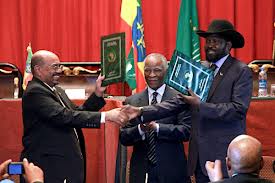
It no doubt came as a surprise to many when the government of Sudan announced that its leader, the ICC-indicted President Omar al-Bashir was to make a visit to neighbouring South Sudan, a country which split from the Sudan in 2011 following independence and with whom they have been engaged in conflict since the aforementioned split. It was even more of a surprise when President al-Bashir followed through on his promise by visiting South Sudan in the past week. The visit signals a softening and warming in relations between both countries who until 2011 had been engaged in conflict which claimed the lives of an estimated two million people.
 
Recent conflict between both nations was the result of disputes over the ownership of oil rich regions bordering the countries. The dispute threatened to plunge the region into anarchy, a state from which it has hardly recovered following decades of fighting, but for the inspired intervention of the much maligned African Union (AU) who stepped in in time to prevent the escalation of hostilities. A demilitarised zone, akin to that in place in the Korean peninsula, established in March of this year is the legacy of the recent conflict.

Whether the pleasantries and niceties exchanged between both countries’ leaders at last week’s meeting will become a permanent feature of their relationship largely remains to be seen although if their leaders’ statements are anything to be relied upon then one may well surmise that a new dawn is set to spring upon the North African terrain. For his part, al-Bashir proffered, “We won’t go back to war. President (Salva) Kiir and I agreed that the war was too long.” His counterpart Kiir, also accepted an invitation to pay al-Bashir a return visit.

It is to the credit of both nations and the AU that the threat of war has seemingly been extinguished, albeit temporarily. The symbiotic relationship between both is however one which has been overlooked as constituting a catalyst for the improvement in relations between the countries. The production of oil, a resource which accounts for a substantial part of both countries’ economies, virtually ceased almost throughout 2012 and which, as expected, has had a devastating impact on their economies. For all the ills associated with oil, human rights abuses, totalitarian regimes, rouge states et al, oil, for once, should be given credit for perhaps saving the lives of innocent civilians who would no doubt have become engulfed in another senseless conflict. Both countries’ fortunes, like that of twins, are inextricably linked and as such their leaders, Kiir and al-Bashir, will do well to heed the mantra “together we stand and divided we fall”, as only then will the cessation of hostilities be rooted in permanence.

Saturday, 6 April 2013

VENEZUELA: EVEN IN DEATH, CHAVEZ’S SHADOW LOOMS LARGE


Now that the dust has settled, or to an extent settled, following the death of, for want of a better word, the behemoth of South American and perhaps global politics, Hugo Chavez, the country is now in that most perilous of situations which has confronted many a nation in the aftermath of a revolution. As tears begin to dry up and the demand for tissue paper to wipe the same off Venezuelan faces recedes, the reality of a post-Chavez Venezuela gradually dawns upon its people not least owing to the rapidly approaching election date of 14th April which seems to have snuck up on followers of South American politics with a fair degree of stealth.

While Nicolas Maduro, the Chavez-anointed acting President and favourite to bag the election attempts and fails to ape the awe inspiring persona of the late great Chavez, his rival Henrique Capriles, despite being behind in the polls, appears to be making some headway, albeit while at the same time acquiring enemies at the rate of knots in the run-up to elections.
 
Capriles’s modus operandi is one which principally consists of highlighting the numerous claims of government excesses and corruption with which its government officials are currently bedevilled. Not letting up on his attacks, perhaps having learnt a thing or two about the attack dog style of the erstwhile President Chavez, Capriles attended several rallies organised by his supporters in which he wasted no time in ‘sticking it’ to his foes. Referring to claims of endemic corruption within government circles, Capriles told the partisan crowd: “They talk of socialism, but it’s on the surface only. Look how those well-connected ones live, what they wear, what cars they go round in, how many bodyguards they have.” Ratcheting up the rhetoric, Capriles topped things off by labelling his opponents “skin-deep socialists”.
 
Whether this newly unveiled firebrand persona will be enough to see Capriles through to victory is anybody’s guess although recent polls show that Capriles’s Democratic Union Party still lag behind the ruling Socialist Party. For Capriles, the difficulty lies in convincing sufficient numbers of the electorate that the country requires a movement away from Chavez’s imbued socialist principles and ideals which has served the country’s ordinary folk so well in recent years to the centrist position which Capriles’s party advocates. While Capriles is no doubt a very able politician, he is perhaps finding that his toughest battle is not against the incumbent Maduro but against a dead man in the form of the indefatigable figure of Chavez whose ghost lurks in the background. The reality therefore is such that even if Maduro does no campaigning from today’s date until the date of the election, the groundswell of emotion following Chavez’s death is more than likely to see him through to the finish line, proving that even in death, Chavez remains the force of nature which he certainly was in lifetime.

Sunday, 24 March 2013

CENTRAL AFRICAN REPUBLIC: REBELS FINALLY OVERTHROW GOVERNMENT

Several weeks ago 1worldinternational reported on the ongoing military conflict between government forces and rebels (the Seleka rebel coalition) seeking the overthrow of the President Francois Bozize-led government (Central African Republic: Rebels Closing in on Power published on 4th January 2013). At the time it appeared as if a compromise peace deal had successfully been brokered which would see President Bozize remaining in power for a further three years and until 2016 when presidential elections are scheduled to be held in the country.
 
If early reports are to be believed, hopes of a working compromise appear have been short-lived following the rebels’ renewed attacks against the government. At the time of writing, the rebels are said to have forced their way into the country’s capital of Bangui with President Bozize fleeing the country in the process. It is as yet unclear as to why the rebels acted in breach of the peace accord agreed in January between themselves and the government although observers couldn’t assert with any confidence at the time that the peace agreement had any chance of lasting its course.

At the time of writing, news emanating from the country is that about nine South African and three Chadian soldiers were also killed by fighters linked to the rebels during the recent upheaval. The South Africans have provided military assistance to the Central African Republic government forces for sometime while Chad and the Central African Republic maintain close ties, not only because of the relationship between President Idriss Deby of the former and President Bozize of the latter since Bozize gained power by way of a coup in 2003, but also because Bozize has relied heavily on the Chadian forces’ military might in dealing with various uprisings which have become commonplace following his assumption of power.

The fall-out from the rebels’ success in the region in which the country is surrounded is expected to be of seismic proportions not least because the country’s neighbours have to some extent propped up President Bozize’s regime and have assisted militarily in attempting to extinguish the rebels. To this extent, President Idriss Deby’s Chad comes to mind. As previous experience indicates, the rebels will be most aware, if they have any sense of course, that the easy part is overthrowing governments whom they perceive to be an obstacle in their path. The difficulty arises in terms of establishing the rule of law and quelling the spates of mass disorder which inevitably follows as an after spill from the turmoil and carnage.

This tinderbox or powder-keg-like state is further exacerbated by the make-up of the rebels who, from the limited information gleaned so far, are essentially a coalition of disparate fighters. One should therefore not expect this marriage of convenience to persist until death do them part. To be fair, the Seleka forces have indicated on several occasions their intention to organise a transition towards democratic elections. Observers of Africa’s fortunes will however assert, at the risk of being labelled pessimists and perpetual killjoys, that we have heard it all before. Nevertheless, the writer will most certainly be happy to be proved wrong.

Saturday, 16 March 2013

CAMBODIA: ANOTHER MASS MURDER SUSPECT ESCAPES JUSTICE


News of the death of Ieng Sary, 87, one of the high level officials of the country’s deposed Khmer Rouge regime, has been met with a range of responses. The responses have broadly fallen into two categories with some ecstatic that Sary has now met his maker and will accordingly be judged for his hand in the pogroms committed in his time on earth and many who are disappointed that Sary will not now face justice as well as his accusers in the courts of law.

Ieng Seng served as foreign minister in the 1970s and at a time at which the country’s leadership was headed by the murderous Pol Pot whose dictatorship was responsible for the killing of between 1.7 and 2.5 million people. In the aftermath of the pogrom, the United Nations (U.N.), with the agreement of the Cambodian government, created the Khmer Rouge Tribunal, now officially referred to as the Extraordinary Chambers in the Courts of Cambodia, with the aim of trying senior and the most culpable members of the regime. The Tribunal’s processes are overseen by locally qualified and international judges working hand in hand to ensure the achievement of objectives placed within its remit, i.e. facilitating access to justice for victims of crimes against humanity, war crimes and genocide committed by the regime between April 1975 and January 1979.

Elisabeth Simmoneau Fort, a legal representative of some of the victims echoed the sentiments voiced by many that Sary’s death is a big blow to the authorities’ efforts which are aimed at bringing those responsible for the mass crimes to book. Ms Fort stated: “For the victims, this death narrows the scope of the trial and limits their search for truth and justice.” She added: “We can say that by death, Ieng Sary escapes justice.”

Sary’s death comes against the background of claims that the Cambodian government has impeded the Tribunal’s efforts by repeatedly interfering in its work and the rather shambolic conviction rates of the Tribunal constitutes, in the writer’s view, sufficient evidence to buttress this. Thus to date, only one high ranking official of the regime Kaing Guek Eav, famously known as “Duch” has been convicted for his hand in the massacres. Compounding matters further is the fact that there are only two surviving high ranking members of the regime, the majority being deceased and one having been declared mentally unfit to stand trial. With the twin evils of government interference and lack of funding impeding the process one finds it difficult to see how an ending which involves the conviction and subsequent imprisonment of those in custody will ever be achieved.

For reasons of expediency perhaps the cases should be transferred to a neutral country, possibly within the area in which Cambodia is located, appointed by the U.N. as this may rid the issue of government interference which is seen as a major stumbling block in the way of the Tribunal. While many call for increased funding of the Tribunal, one struggles to see how this would result in speeding up the process as it is the interference in the first place which has resulted in the gridlock currently being experienced by the Tribunal, and as a consequence, the Tribunal’s costs have risen accordingly. The Tribunal is clearly not short of funding, what with a reported $175 million having been spent in the five and half years from mid-2006 when it was founded to the end of last year. The writer’s sentiments are seconded by Surya Subedi, the U.N.’s special rapporteur on human rights in Cambodia in last week’s speech in Geneva, Switzerland. To sound-off, Subedi, in urging the Tribunal to exhibit some urgency in dealing with the trials, asserted: “We owe it to the surviving victims of the Khmer Rouge, the families of the victims, and the whole of Cambodian society that continues to suffer from the impact of the Khmer Rouge.” Admittedly, the writer couldn’t have highlighted the significance of the trials to the Cambodian people any better than Subedi did.

Tuesday, 5 March 2013

GUINEA: FIGHTING AND RIOTING ENGULF ANOTHER WEST AFRICAN STATE

The West African country of Guinea appears to have been struck by the curse which has afflicted its West African neighbours of late by succumbing to the political crises which has so far threatened to rip the region apart from itself. Protesters, apparently aping the Arab Spring protests, have taken to the streets over the last couple of days clamouring for the sort of change to which the region has become unfamiliar of late.
 
With the attention of regional diplomats being trained on disturbances afflicting neighbouring Chad, Mali and recently the Ivory Coast, the last thing the regional watchdog ECOWAS (the Economic Community of West African States) envisaged at this most inopportune of times was the upheaval which has emanated from Guinea and which most certainly will have the effect of encumbering its already stretched to the limit resources.
 
The protests, which started several days ago, is said to have been the result of President Alpha Conde’s failure to call for elections before the 3rd March 2013 deadline which had been set for that purpose and on which most people had relied. The said elections would have taken place on 12th May 2013. Unfortunately the waters are further muddied by the usual powder keg concoction of ethnic rivalries which when mixed with politics inevitably results in the combustion with which observers of Africa’s fortunes have become too familiar. In this vein, the protests are of added significance not least because it has now transcended mere political disagreements and appear to be a camouflage for the continued feuding between two of the country’s largest ethnic groups, the Malinke and the Peul, with the latter predominantly forming the opposition and the former currently comprising the bulk of the government’s support.
 
At the time of writing, it is reported that at least a dozen people had been killed and over a hundred had suffered injuries following the escalation of the disturbance. At least one of those reported to have lost their lives and several of the injured were said to have been caught up in a round of protests which then led to the country’s security officials opening fire on an unarmed group of protestors. Worryingly the protests, which started in the capital city of Conakry, is now said to have spread to towns located as far as over 200 miles from the epicentre of the unrest. The fact that legitimate protests have apparently been hijacked by miscreants, as has at times been reported on occasions on which there are anti-government protests, cannot be ignored.
 
The leading opposition leader, Cellou Dalein Diallo has blamed the security forces, and by implication, the President for failing to exercise control over them and for attempting to muzzle the voices of protests through intimidation. Mr Diallo asserted: “The President of the Republic has a crucial responsibility to create peace. He needs to agree to listen to others, and to respect his adversaries.” Although there appears to be no end in sight to the rapidly spreading wave of violence, the rioters will best be advised to pause for thought and gaze at their surroundings, comprising landscapes which have been blighted by the scourge of ethnic violence and bringing along with it destruction which will in turn inevitably result in a passage of time to be forever referred to as ‘the lost decades’. Perhaps a look across the horizon and onto neighbouring West African States may well help steer the fortunes of Guinea away from the quagmire into which it stares at the present moment.

Sunday, 17 February 2013

ARMENIA: NO CHANGE EXPECTED TO STATUS QUO FOLLOWING ELECTIONS

Reports suggest that no surprises should be expected from Armenian Presidential elections which are to be held tomorrow. President Serzh Sarksyan, the handpicked successor of former President Robert Kocharian, who is coming to the end of his first five-year term in power is on course to further solidify his stranglehold over Armenian politics if he gains the more than 60 per cent of the popular vote of which he has been projected by election opinion pollsters operating within the country. The 60 per cent tally, if reports are to be believed, will see Mr. Sarksyan win a greater percentage of the votes than he did in 2008.
 
The lead up to the elections has been plagued by allegations of electoral malpractice, fraud and lack of transparency in the system. The lack of confidence in the system, allied with further concerns about the credibility of the elections have inevitably led to fears of low voter turnout, the result of boycotts by eligible voters. These worries have been recognised by the Parliamentary Assembly of the Council of Europe who stated, following last month’s visit to the country, that some of the major political parties which had been “strongly expected to present Presidential candidates, chose not to do so because of their lack of trust in the conduct of the election.”
 
It would be unfair to highlight the pre-election difficulties facing the nation without noting that the country has successfully circumvented the wide scale disturbance which ensued in the course of the last Presidential elections held in February 2008. Nevertheless, recent elections have been tainted by the rather unsavoury assassination attempt on one of the election candidates, Paruyr Hayrikyan, who was shot in the shoulder on 31st January 2013. Luckily the bullet missed Mr. Hayrikyan’s vitals and he has lived to tell the proverbial tale. Further controversy and questions have also been raised about the credibility of the elections with one candidate, Arman Melikyan boycotting the election on the basis that the results had already been predetermined, and another, Andrias Ghukasyan, embarking on a hunger strike and seeking the annulment of the incumbent’s candidacy on account of alleged malpractice.
 
The country, which won independence from its parent nation the Soviet Union in 1991, has failed to live up to the promise which many believed it once possessed pre-independence with poverty and unemployment remaining rife and without any effective programmes being devised by the government to tackle these twin ills. Its economic situation has not been eased by long running conflicts with its neighbours, namely Turkey and Azerbaijan, which has in effect resulted in the imposition of economic blockades which has hampered its growth and development.
 
Its conflict with Turkey emanates from Turkey’s refusal to acknowledge allegations of genocide perpetrated by their troops against ethnic Armenians between 1915 and 1917. Armenia’s dispute with Azerbaijan on the other hand, is the result of claims over the border region of Nagorno-Karabakh. A fragile ceasefire has remained in place since 1994’s ceasefire between both nations. Against the background of both internal and external turmoil facing the nation, one hopes that next week’s election passes off peacefully and without incident. If this occurs, it may well set the country on the road to achieving the promises which many felt it held pre-independence and immediately after its independence in 1991.
 

Sunday, 10 February 2013

NIGERIA: THE FIGHT AGAINST POLIO SUFFERS SIGNIFICANT SETBACK


Worryingly, one has become rather immune to horror stories emanating from Africa’s most populous country such that news of the killing of nine health workers said to be administering polio vaccines in northern Nigeria has not come as a shock.
 

Boko Haram: The History
 
Regular visitors to the 1worldinternational weblog will be aware of the origins of Boko Haram, the terrorist group with Nigerian origins which has over the last few years masterminded attacks against the Nigerian government, public infrastructure, civilians and churches. In a previous article entitled “Boko Haram: The New Al-Qaeda?”, 1worldinternational highlighted the threat posed by the group. The article also covered fears raised by the U.S. about the Nigerian government’s inability to deal with the insurgency and the prospect that the national problem may spiral into an international concern.
 
As always, the Boko Haram Islamist sect which opposes polio vaccination programmes, for what many term the misguided reason that it is a Western-led ploy to inflict AIDS on Muslim children and cause infertility within that cross-section of the Nigerian society, have been blamed for the killings.  This week’s attack follows a similar attack against aid workers in Pakistan who had been administering polio medicine to those most prone to the disease. Police spokesman Magaji Musa explained: “Gunmen on bikes opened fire on a health centre in the Hotoro district killing seven, while an attack on the Zaria Road area of the city claimed two lives.” Musa continued: “They were working for the state government giving out polio vaccinations at the time of the attack.”
 

Blow to Worldwide Fight against Polio
 
The latest attacks on health personnel in Pakistan and Nigeria, allied with the continued threats to the lives of aid workers in these regions, is indeed a massive blow to worldwide efforts currently geared towards the eradication of the disease. In June of last year, 1worldinternational reported, in an article titled ‘Global Polio Eradication Initiative (GPEI) Declares Last Stand against Polio’, the Global Polio Eradication Initiative’s launch of an emergency action plan following fears of a resurgence of the disease in countries where the disease was thought to have been eradicated. By way of information, the GPEI was formed in 1988 and was spearheaded by the WHO, Rotary International, the United States Center for Disease Control and Prevention and UNICEF. It is also supported by polio-affected and donor governments, private foundations, development banks, humanitarian and non-governmental organizations, corporate partners and more than 20 million volunteers.
 
It is perhaps no coincidence that the countries in which the most stubborn and obdurate opposition to the administration of medicine emanates are those – Afghanistan, Pakistan and Nigeria -  in which polio remains endemic to levels needed to prevent the transmission of the disease. The December 2012 and January 2013 attacks by alleged Taliban-linked militants in Pakistan is indication of the continued lack of understanding which is required from leaders of these communities if the Ban Ki-moon led quest to “stamp out polio for good” is to be achieved in our lifetime.
 

Sound-off
 
In the circumstances, the GPEI and those leading the fight against the dissease are left with essentially three options. The first and least favoured is continuing with the same course of action, i.e. sending in aid workers against the background of the real and severe risks of attacks on their person. The second and middle of the road option entails praying and hoping that the military might of the North Atlantic Treaty Organisation (NATO), the International Security Assistance Force (ISAF) and the Nigerian government will prevail over those of the Taliban, its allies and the Boko Haram military sect. The third and most preferable option, and which in the writer’s view is most likely to yield the most dividends, is that of engaging and educating the opponents of the vaccination programme about the advantages of immunization to future generations of Muslim children. Perhaps this will, to some extent, assuage fears which manifests itself in the form of misguided views in respect of the aims and objectives of the programme.
 
In this regard, charity organisations who operate within the Islamic world such as the Red Crescent may act as mediators and/or negotiators owing to the fact that they may not face the same allegations levelled aganst Western-backed organisations and aid workers which is that they are acting as agents of the West and that they are essentially, propagating and cultivating a Western-backed agenda. Unfortunately, without the co-operation of the current opponents of the vaccination programme, who also wield such overarching power and influence over the regions in which it is most prevalent, the battle against the disease will be one with which future generations will be saddled.